Bathroom Vanity Lighting Lumens: The 2026 Complete Guide
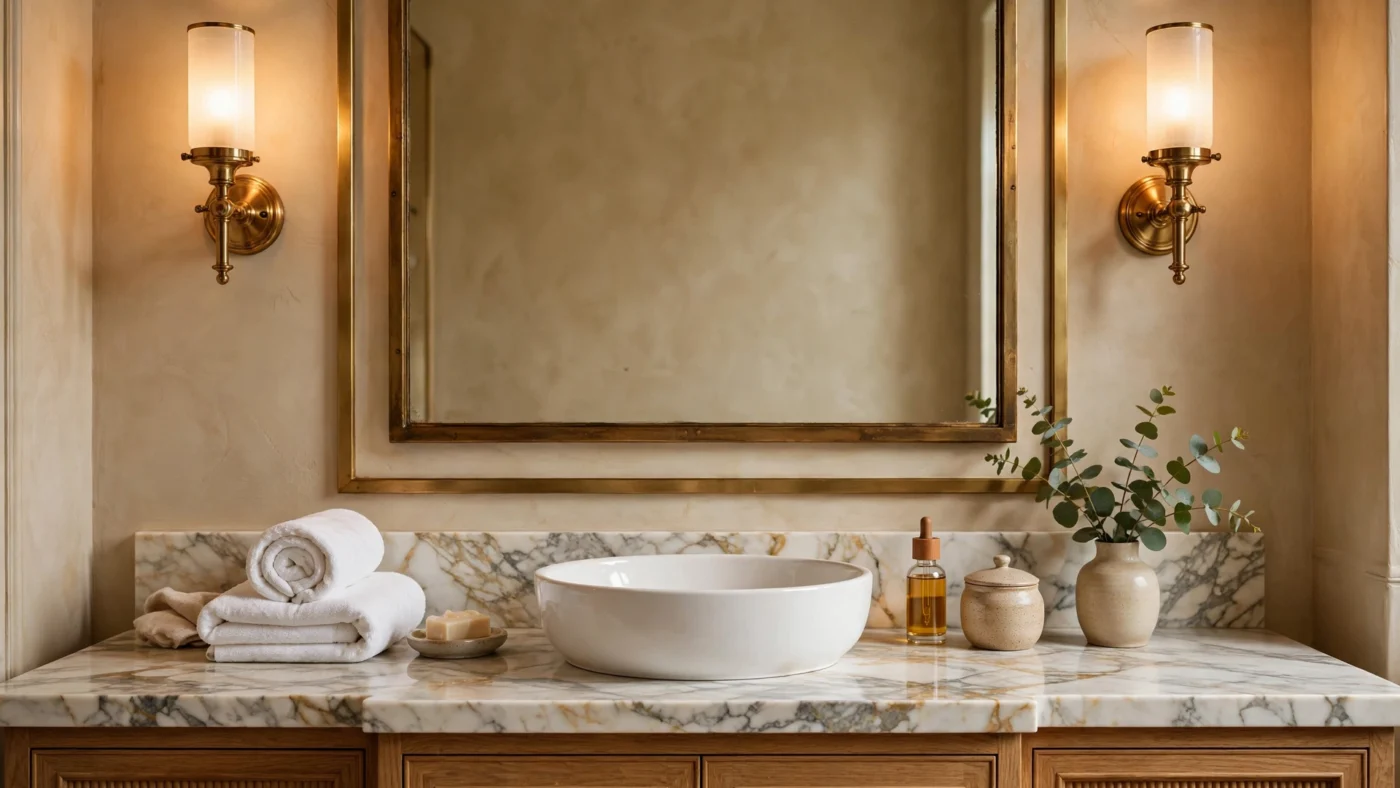
Bathroom vanity lighting lumens are the difference between a mirror you trust and one you second-guess. Most people pick a fixture they like, screw in a bulb, and live with shadows under their eyes for years — never realizing the fix is math, not guesswork. Get the lumens right, place the fixtures at the right height, and the same bathroom suddenly feels like a hotel spa.
This guide walks you through the full formula: how many lumens your vanity needs, a worked example for a real double vanity, fixture-by-fixture placement rules, the color temperature that flatters skin instead of washing it out, and the mistakes that make expensive bathrooms look cheap. Run your own numbers anytime with our Luxury Lighting Calculator.
Bathroom Vanity Lighting Lumens: How Many Do You Need?
When you’re sizing bathroom vanity lighting lumens, start at the mirror — the task zone where you shave, apply makeup, or style hair. The industry sweet spot is 1,600 to 2,400 lumens for a single vanity and 3,000 to 4,000 lumens for a double vanity. These are task-lighting numbers, measured at face level, not the total light in the room.
Why a range and not a single number? Four things move your ideal bathroom vanity lighting lumens up or down inside it:
- Vanity width. A 24-inch single sink needs the low end; a 60-inch double needs the high end. Light must reach every inch of both faces.
- Wall and tile color. Glossy white tiles bounce light around and can shave 15–20% off your needs. Dark matte stone or deep green tile absorbs it — budget for the top of the range.
- Natural light. A bathroom with a generous window needs fewer artificial lumens during the day. Windowless interiors need the full amount, all the time.
- Your routine. Makeup application and detailed grooming demand more light than brushing teeth. If the vanity is a daily styling station, aim high.
For the bathroom as a whole, general guidance is around 70–80 lumens per square foot of ambient light. A 50-square-foot bathroom needs roughly 3,500–4,000 lumens in total — the vanity provides about half of that, and a ceiling fixture, shower light, or night light supplies the rest.
The Worked Example: A 60-Inch Double Vanity
Let’s run the bathroom vanity lighting lumens math for a common luxury setup: a 60-inch-wide double vanity with two sinks and one wide mirror.
- Step 1 — Set the per-sink target. Each sink station is a single vanity: 1,600–2,400 lumens. For a grooming-heavy household, target 2,000 per side.
- Step 2 — Multiply. 2,000 lumens × 2 sinks = 4,000 lumens at the mirror.
- Step 3 — Choose the fixtures. Two vertical sconces (one per side of each mirror zone) at 900 lumens each, plus a 36-inch LED bar over the mirror at 2,200 lumens = 4,000 lumens.
- Step 4 — Add ambient. A 50-square-foot bathroom at 75 lumens per square foot needs 3,750 lumens total. The vanity delivers 4,000 — the ceiling light only needs to fill corners and the shower, roughly 800–1,000 lumens.
Notice the conclusion: when your bathroom vanity lighting lumens are dialed in, you don’t need a blazing ceiling light at all. That’s exactly how luxury bathrooms feel calm instead of clinical.
Try your own dimensions in our Luxury Lighting Calculator to get a room-by-room lumen plan in seconds.
The Fixture-by-Fixture Plan
Bathroom vanity lighting lumens tell you how much light you need. Placement tells you whether it lands on your face or casts horror-movie shadows.
1. Side sconces: the non-negotiable layer
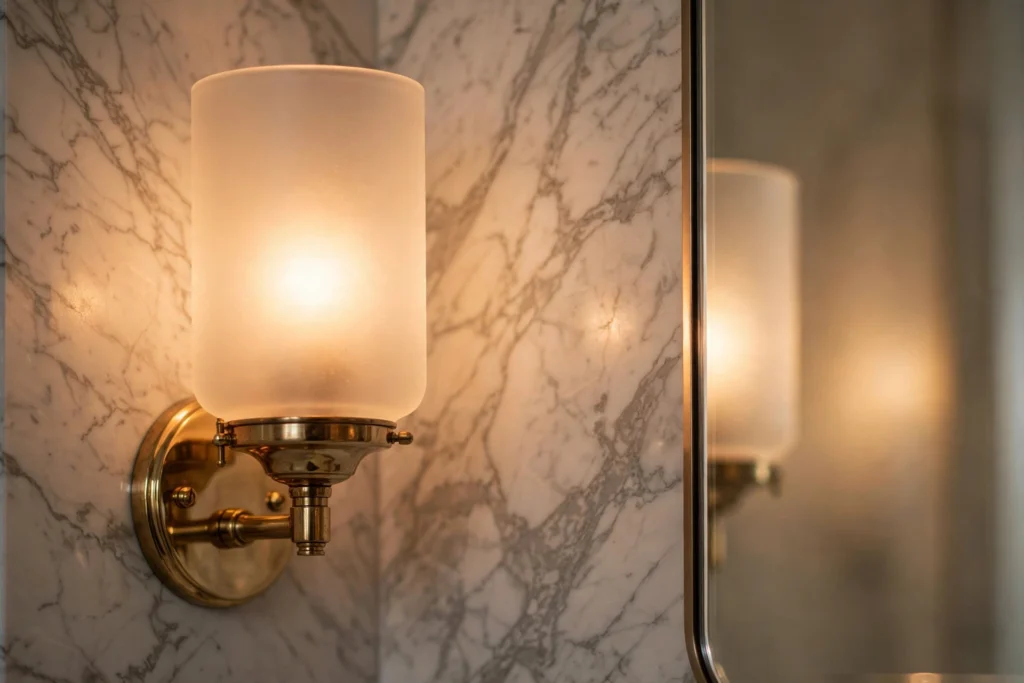
The single most important vanity lighting rule: light should come from both sides of the face, at eye level. A pair of sconces flanking the mirror — or vertical fixtures between two mirrors — wraps light evenly across cheeks, chin, and forehead, which is why makeup artists and barbers insist on it.
- Mount sconces 36 to 40 inches apart, centered on the mirror, at 60 to 65 inches from the floor (roughly eye level for most adults).
- Each sconce should carry one-third the height of the mirror — so a 30-inch mirror pairs with 10-inch sconces.
- Shade the bulbs or use frosted glass. Bare bulbs at eye level create glare, which defeats the whole point.
2. The overhead bar: your second layer
A linear LED bar or multi-globe fixture above the mirror adds the missing top-down fill to your bathroom vanity lighting lumens plan. Size it to about 75% of the mirror’s width, mounted 75 to 80 inches from the floor — never so low that it crowds the mirror’s top edge.
3. Backlit and LED-integrated mirrors
Backlit mirrors — where the light glows from behind the glass — have become the signature luxury look because they eliminate fixtures entirely while delivering perfectly even light. Check the spec sheet: many decorative LED mirrors only output 800–1,200 lumens, which is ambient, not task, lighting. For grooming, pair a backlit mirror with at least one sconce pair.
Color Temperature and CRI: The Flattering-Light Specs
Bathroom vanity lighting lumens measure brightness; two more specs determine whether you look good in that brightness.
- Color temperature: 2,700K to 3,000K. Warm white is the luxury default — it flatters skin tones and reads “spa.” Anything above 4,000K (daylight/cool white) makes a bathroom feel like a dentist’s office and casts blue-gray tones on skin. Keep every vanity bulb within the same 300K range, or mismatched tones will look sloppy.
- CRI 90 or higher. The Color Rendering Index measures how accurately a light shows true colors. For makeup, anything below CRI 90 is a gamble — foundation shades and blush tones shift under poor rendering. Most quality LED vanity bulbs now list CRI 90+ on the box; if the spec is missing, don’t buy it. (The Wikipedia entry on color rendering index explains why this number matters more than wattage for grooming.)
One more rule: pick your temperature once and repeat it everywhere in the bathroom. A 2,700K vanity next to a 5,000K shower light is the fastest way to make a premium bathroom feel unfinished.
Dimming: The Difference Between Task and Spa
Once your bathroom vanity lighting lumens are dialed in, a vanity stuck on one brightness setting is still a design compromise. Install dimmers on every vanity circuit and you get two rooms for the price of one:
- Full brightness for morning grooming, makeup, and cleaning.
- 30–40% brightness for an evening bath — warm, low light that turns the bathroom into a retreat.
Use LED-rated dimmers (not legacy incandescent ones) and confirm the fixtures are marked dimmable — flickering at low settings is the telltale sign of a mismatch. Smart dimmers add scenes: “Makeup” at full, “Bath” at low, and a warm 2,700K nightlight mode for 2 a.m. trips.
5 Lighting Mistakes That Cheapen a Luxury Bathroom
- A single overhead light and nothing else. One ceiling fixture above the vanity throws shadows down your face — chin, nose, eye sockets all go dark. It’s the most common mistake in expensive bathrooms.
- Bare bulbs at eye level. Exposed filament bulbs look great on Instagram and terrible in person. Frosted shades or diffusers are mandatory for flattering light.
- Mixed color temperatures. Warm sconces plus cool overheads, or a 3,000K mirror light against 5,000K downlights, makes the whole room feel unconsidered.
- Under-lighting a dark bathroom. Charcoal tile, black marble, and navy walls can swallow 30% of your lumens. If your palette is dark, size the fixtures up, not down.
- No dimming. A bathroom that’s blinding at 10 p.m. is a bathroom you avoid. Dimmers are the cheapest luxury upgrade in the entire house.
Bathroom Vanity Lighting FAQs
How many lumens do I need for a small single vanity?
For a small single vanity, the right bathroom vanity lighting lumens total is 1,600 to 2,400 at the mirror (for a 24- to 36-inch vanity). Go toward the top of the range if the bathroom has dark tile or no window.
Should vanity lights go above the mirror or on the sides?
Sides first. For the best bathroom vanity lighting lumens, sconces at eye level on both sides of the mirror give the most shadow-free, flattering light. An overhead bar is an excellent second layer, but it should never be the only layer.
What is the best color temperature for bathroom vanity lighting?
2,700K to 3,000K — warm white — flatters skin and feels luxurious. Pair it with CRI 90+ bulbs so colors render accurately for makeup and grooming.
Can I use a backlit mirror as my only vanity light?
Usually not. Most decorative LED mirrors output 800–1,200 lumens — ambient light, not the bathroom vanity lighting lumens you need for task lighting. Add a sconce pair or an overhead bar to reach the 1,600–2,400 lumen target.
How high should vanity sconces be mounted?
60 to 65 inches from the floor to the center of the sconce — roughly eye level. Space them 36 to 40 inches apart, centered on the mirror.
The Quick Sizing Cheat Sheet
Pin this bathroom vanity lighting lumens cheat sheet before you shop:
- Powder room / single sink: 1,600–2,000 lumens — one pair of sconces usually covers it.
- Full bath / double sink: 3,000–4,000 lumens — sconce pair plus an overhead bar.
- Master suite / wide mirror: 4,000+ lumens — consider a backlit mirror plus sconces.
- Always: 2,700–3,000K, CRI 90+, every circuit dimmable, no bare bulbs at eye level.
Plan It Before You Buy
Getting your bathroom vanity lighting lumens right is one of those purchases where guessing costs real money — the wrong fixtures get ripped out and replaced. Do the math first: measure your vanity, pick your layers, and run the numbers through the Luxury Lighting Calculator to get a precise lumen plan for your exact room. For the design side — mirror styles, material pairings, and the storage to match — see our luxury bathroom design ideas and the companion bedroom lighting lumens guide for the rest of the suite.