Bedroom Lighting Lumens: The 2026 Complete Guide
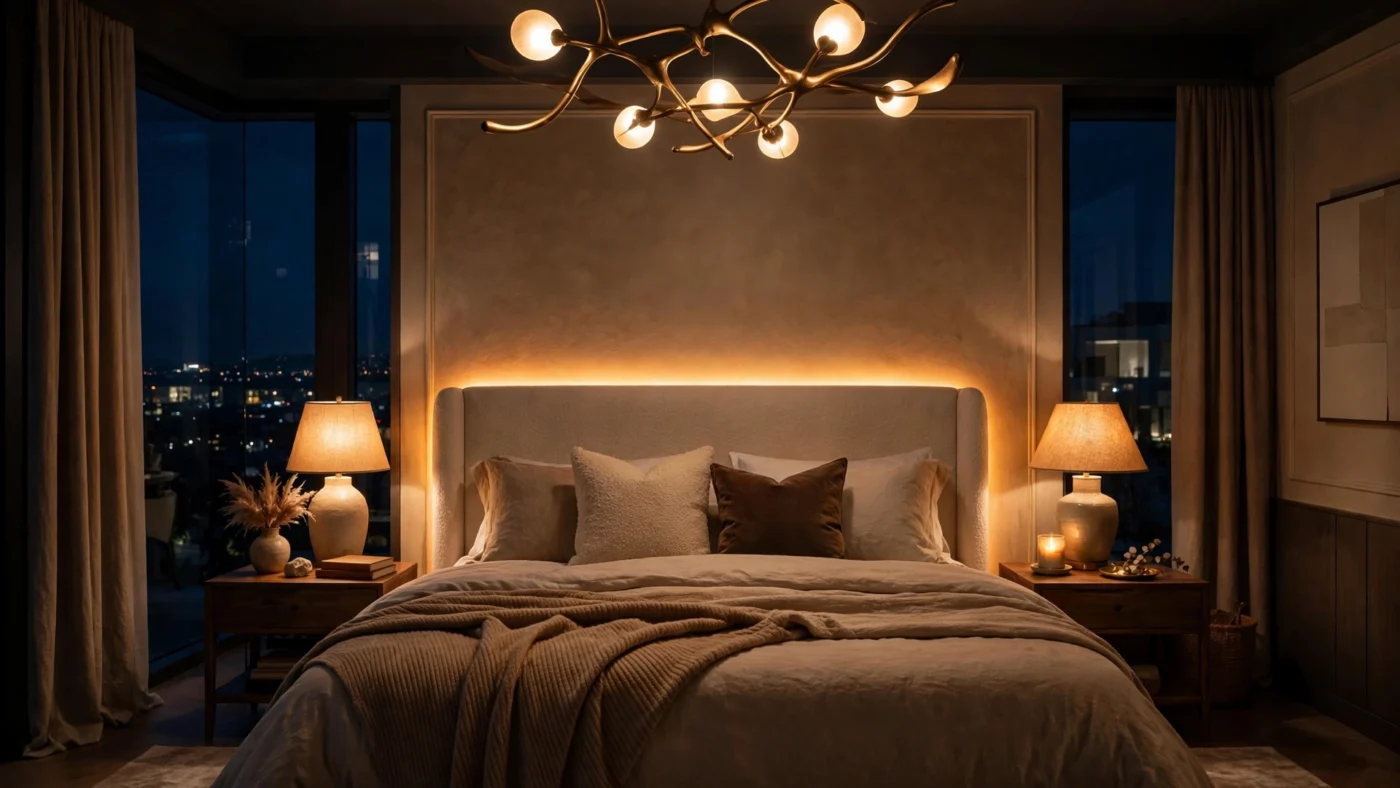
How Many Lumens Does a Bedroom Need?
Getting bedroom lighting lumens right starts with one rule: 10 to 20 lumens per square foot of floor space (roughly 100 to 200 lumens per square metre). A bedroom sits at the calmer end of home lighting — it needs less raw brightness than a kitchen or home office, because the room’s job is rest, not precision work. Where a living room tolerates 20 to 30 lumens per square foot, a bedroom feels luxurious at 10 to 20.
That one fixture in the ceiling is not the plan. The plan is a total lumen budget spread across several layers — ambient, task, and accent — so you can shift from bright and functional at 7 PM to candle-soft at 11 PM without touching a bulb.
Instead, plan the total bedroom lighting lumens first, then spread them across layers.
If you would rather skip the arithmetic, try the Luxury Lighting Calculator — enter your room dimensions and it works out the lumen target for you.
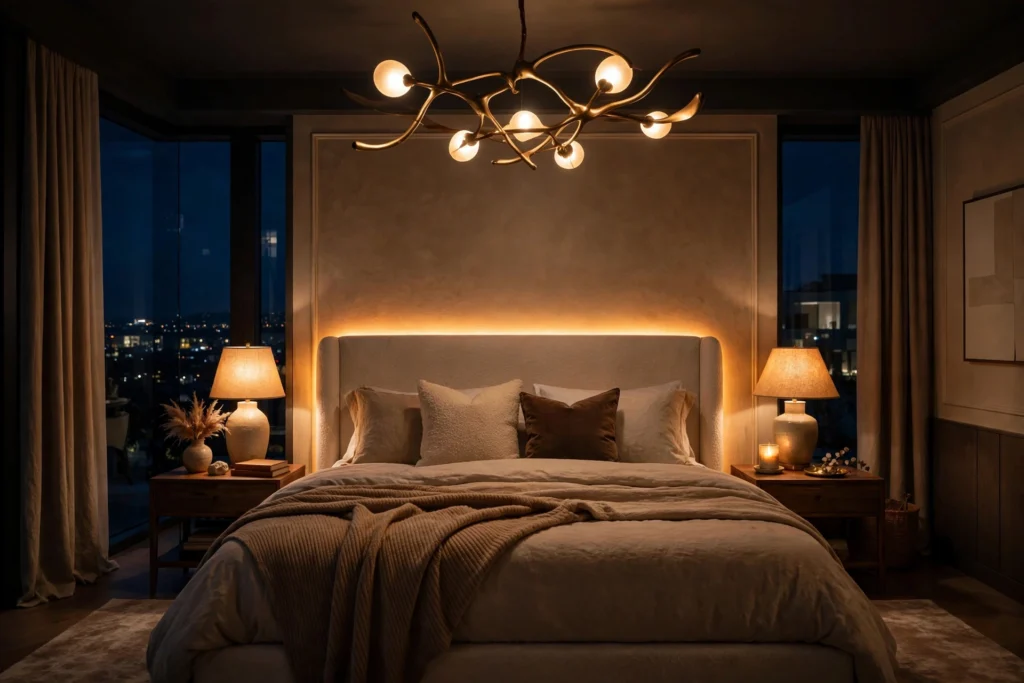
Bedroom Lumens: A Worked Example
To see bedroom lighting lumens in action, take a typical primary bedroom: 12 by 14 feet (168 square feet).
- Lower end: 168 × 10 = 1,680 lumens
- Upper end: 168 × 20 = 3,360 lumens
Aim for the middle — about 2,500 lumens — and split it across layers:
- Ambient (overhead): ~1,500 lumens — one ceiling fixture or two smaller ones
- Task (bedside reading): ~700 lumens — split between two nightstand lamps or sconces
- Accent (mood/decor): ~300 lumens — LED strip behind the headboard, a picture light, or a small dresser lamp
Go brighter rather than dimmer, then add dimmers everywhere. Light you can turn down is luxury; light that is stuck too dim is just annoying. A room that feels bright at 8 PM and melts to a warm glow at 10:30 is the goal.
Nail your bedroom lighting lumens budget first — fixtures second.
The Three-Layer Bedroom Lumen Budget
1. Ambient light — the foundation
Ambient light is your room’s general illumination after dark. In the example bedroom, the ambient layer carries about 1,400 to 1,600 lumens. One 1,600-lumen ceiling fixture (roughly a 16W LED) covers it, or two 800-lumen fixtures for more even coverage. Cove lighting along the ceiling perimeter counts too — a dimmable LED cove at full output often delivers 300 to 500 lumens of beautiful indirect glow.
2. Task light — reading, dressing, working
Reading in bed is the bedroom’s main task. Each bedside fixture should deliver 300 to 500 lumens, aimed at the page, not into your partner’s eyes. Two bedside lamps at 400 lumens each hit the 700-800 lumen task budget comfortably. A dressing corner or vanity wants another 400 to 600 lumens of focused light — a wall-mounted spot or an illuminated mirror does it without cluttering the room.
3. Accent light — the luxury layer
This is the layer that makes a bedroom feel designed rather than merely lit. LED tape behind the headboard (about 200 to 300 lumens over a queen-size bed), a small picture light over artwork (200 to 400 lumens), or a sculptural table lamp on the dresser.
Accent light stays under 500 lumens total — its job is atmosphere, not visibility.
A layered bedroom lighting lumens plan plays best against the right backdrop — see these bedroom color schemes that never fail.
| Fixture | Typical lumen target | LED wattage equivalent |
|---|---|---|
| Ceiling fixture (ambient) | 1,400–1,600 lm | 14–16W LED |
| Each bedside lamp (task) | 300–500 lm | 4–6W LED |
| Wall sconces, pair (task) | 600–800 lm | 6–8W LED |
| Reading swing-arm (task) | 350–450 lm | 4–5W LED |
| Headboard LED strip (accent) | 200–300 lm | 3–4W LED strip |
| Picture light (accent) | 200–400 lm | 3–4W LED |
| Dresser lamp (accent) | 200–400 lm | 3–4W LED |
Bedroom Fixture Placement Rules
Numbers without placement are just theory. These are the measurements lighting designers actually use:
- Bedside lamps: the bottom of the shade should sit roughly level with your shoulder when you sit up in bed — typically 24 to 30 inches above the mattress. Too low and the light hits the book at a glare angle; too high and it lights the ceiling instead of the page.
- Wall sconces flanking the bed: mount them 60 to 66 inches from the floor (about 24 to 30 inches above the mattress top). Swing-arm versions should extend 12 to 16 inches so the light clears the pillow.
- Pendants over nightstands: hang the bottom of the shade 24 to 30 inches above the nightstand surface. They free up the entire nightstand top — a real luxury in smaller bedrooms.
- Ceiling fixture: center it in the room, not over the bed — unless the bed is centered on the main wall, in which case a fixture over the foot of the bed feels intentional. With 8-foot ceilings choose flush mount; at 9 feet or more, a semi-flush or small chandelier adds presence.
- Closet and dressing area: light the inside of the closet, not just the room around it. One 400-lumen LED strip per closet rod section beats any amount of ambient spill.
Color Temperature: The Sleep Factor
Color temperature matters more in a bedroom than anywhere else, because light is a biological signal. Cool, blue-rich light (4000K and up) suppresses melatonin and tells your brain it is daytime — exactly what you do not want at 10 PM.
The right bedroom lighting lumens also protect your rest: keep them low and warm after sunset, and pair the right bulbs with these bedroom hacks for better sleep.
- 2700K to 3000K (warm white): the default for every ambient and bedside fixture. 2700K reads candle-warm; 3000K is warm but crisper.
- 3500K maximum for a dedicated desk or vanity zone inside the bedroom, and only if you genuinely work there.
- Tunable white / warm-dim LEDs: the 2026 answer. These bulbs shift from 3000K down to a candle-like 2200K as you dim them — bright enough for the morning, amber enough for midnight. Pair them with compatible dimmers to avoid flicker.
Rule of thumb: if the light in your bedroom looks like office lighting, the color temperature is wrong, whatever the fixture costs. When in doubt, choose warmer and dimmer — bedroom lighting lumens should whisper, not shout.
Dimming: The One Upgrade That Changes Everything
If you do one thing after reading this guide, put dimmers on the bedside and ceiling fixtures. A dimmer turns a single 1,600-lumen ceiling fixture into everything from full brightness for cleaning to a 100-lumen glow for winding down. Two practical notes:
- Use LED-rated dimmers matched to your bulbs. Old incandescent dimmers cause flicker and buzz with LEDs.
- Choose warm-dim bulbs for fixtures you dim often — they drop in color temperature as they dim, mimicking sunset instead of just going grey.
Smart dimmers add scenes: “morning” at 100%, “evening” at 40%, “sleep” at 5%. Once you live with scenes, a single on/off switch feels primitive.
Five Bedroom Lighting Mistakes That Kill the Mood
- Overhead cans as the only source. Recessed downlights flatten everything — including faces. They are fine as one layer among several, never the whole plan.
- Bedside shades that are too dark. A black or deep-grey shade looks striking and kills reading light. Choose light-toned shades that glow.
- No dimmers. A bedroom without dimmers has exactly one mood. That is not a mood, it is a ceiling.
- Cool-white bulbs. Anything above 3500K in a bedroom fights your sleep. Swap them for 2700K.
- One central pendant hung too low. Over a bed, keep ceiling fixtures at least 7 feet above the floor — you should never feel it looming.
Try the Luxury Lighting Calculator
Every number in this guide started from one formula: room size times target lumens. Try the Luxury Lighting Calculator — enter your bedroom’s length and width and get your total lumen target plus a suggested split across ambient, task, and accent layers. Then come back and match fixtures to the numbers.
Bedroom Lighting FAQs
How many lumens do I need for a 12×12 bedroom?
A 12×12 bedroom is 144 square feet. At 10 to 20 lumens per square foot, the target is 1,440 to 2,880 lumens total — aim for about 2,200, split across an ambient ceiling fixture (~1,300), two bedside lamps (~600 combined), and accent light (~300).
Is 800 lumens enough for a bedroom?
No — 800 lumens is one layer, not a whole room. A single 800-lumen bedside lamp is fine as your reading light, but a bedroom needs 1,500 to 3,000 lumens total across all fixtures, dimmed down for the evening.
What is the best color temperature for bedroom lighting?
2700K to 3000K (warm white) for ambient and bedside light. It relaxes the eye and supports melatonin production. Reserve anything cooler than 3500K for a dedicated work desk only.
Should bedroom lights be dimmable?
Yes — dimmers are the single most impactful bedroom lighting upgrade. They let one set of fixtures serve bright mornings and sleep-ready nights. Use LED-rated dimmers and warm-dim bulbs to avoid flicker.
How high should bedside lamps be?
The bottom of the lampshade should sit about 24 to 30 inches above the mattress, roughly level with your shoulder when sitting up. For wall sconces, mount them 60 to 66 inches from the floor.
A bedroom is the one room where lighting should follow your biology, not fight it. Get the bedroom lighting lumens budget right, layer it across fixtures, dim it warm — and the room starts working the way a bedroom should.