Kitchen Lighting Lumens: The 2026 Complete Guide
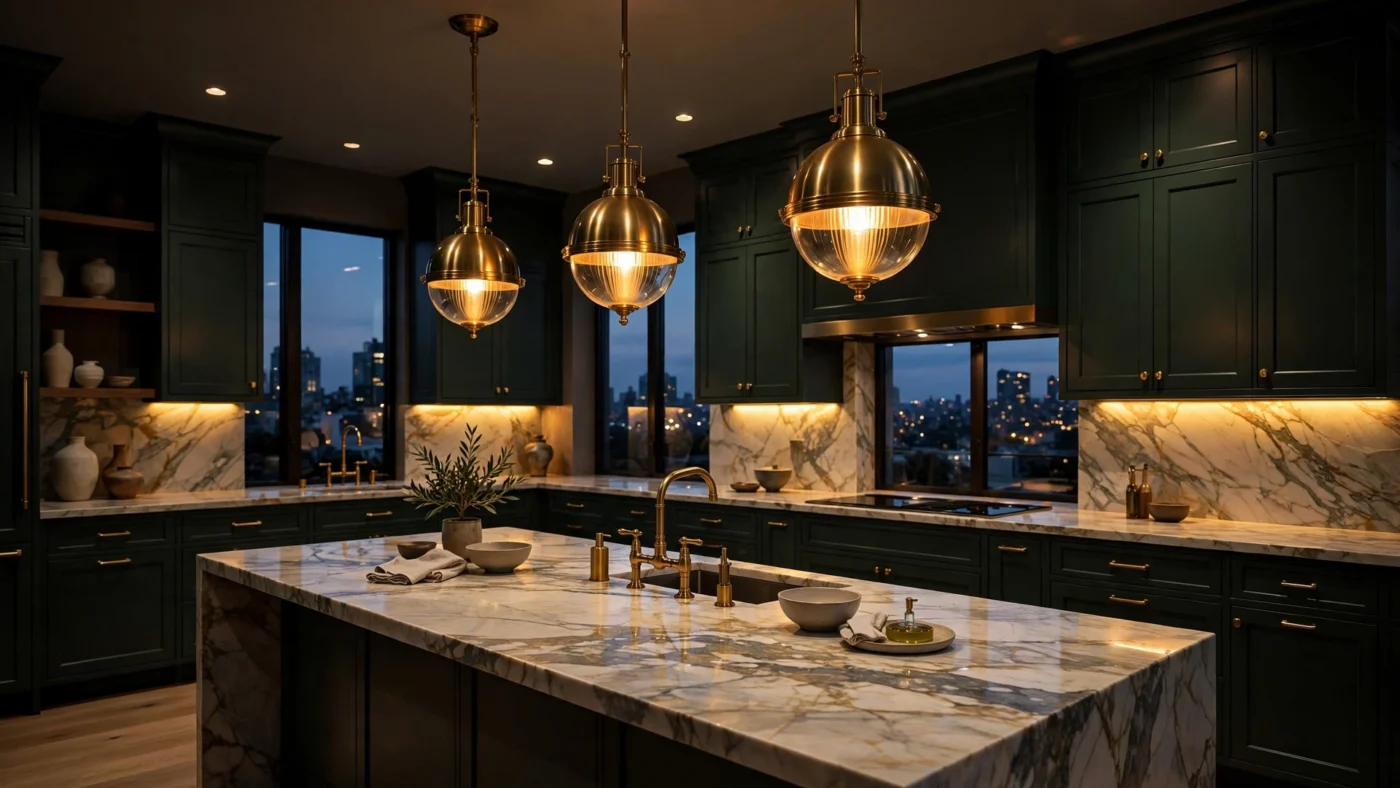
Why Most Kitchens Are Underlit (Even Expensive Ones)
Getting kitchen lighting lumens right is what separates a showpiece kitchen from a working one. Walk into a newly renovated kitchen with stone counters and custom cabinetry, and you will often find the same flaw: one bright ceiling fixture doing all the work. The room looks fine from the doorway, but the moment someone starts chopping vegetables, their own shadow falls across the cutting board. The island glows while the corners go dim. It feels less like a chef’s workspace and more like a showroom.
The problem is almost never the fixtures themselves. It is the math behind them. Kitchens are the hardest-working room in the house, and they need a kitchen lighting lumens plan built on real numbers — lumens per square foot, planned by zone — rather than a single “bright enough” guess. This guide walks you through exactly how to do that, step by step, with a worked example you can adapt to your own kitchen.
The Kitchen Lighting Lumens Budget: Start With the Numbers
Lighting designers commonly recommend 70 to 80 lumens per square foot for kitchen task areas — the counters, island, sink, and stove where real work happens — and 30 to 40 lumens per square foot for general ambient light across the room. Those two numbers are the foundation of your kitchen lighting lumens plan.
Here is the simple method:
- Measure each work zone. Note the square footage of counter runs, the island, the sink wall, and the cooktop area.
- Multiply by the target. Task zones get 70-80 lumens per square foot; the whole room gets 30-40 for ambient.
- Split the total across fixtures. A single fixture doing everything creates shadows; several sources spread across the zones do not.
- Subtract daylight. A kitchen with big windows needs less daytime artificial light, but always plan for the evening, when the room gets zero help from the sun.
Worked example: a 10 x 12 ft kitchen
Take a kitchen measuring 10 by 12 feet — 120 square feet total.
- Task zones: roughly 40 square feet of counter, island, and sink area. At 75 lumens per square foot, that is 3,000 lumens of focused task light.
- Ambient: 120 square feet at 35 lumens per square foot gives 4,200 lumens of general light.
- Combined target: about 7,200 lumens total, delivered by several fixtures — not one.
Translate that into fixtures: four 900-lumen recessed cans (3,600 lumens) for ambient, a pair of 800-lumen island pendants (1,600), and two 1,000-lumen under-cabinet runs (2,000). That is 7,200 lumens with every zone covered and no single harsh source. Want to run these numbers for your own room dimensions? Try the Luxury Lighting Calculator — enter your room size and it does the zone-by-zone math for you.
The Four Kitchen Lighting Zones (and What Each Needs)
A luxury kitchen is never lit as one space. It is four zones, each with its own job — and its own kitchen lighting lumens budget.
1. Under-cabinet task lighting: the workhorse
This is the single highest-impact upgrade in any kitchen. Light mounted under the wall cabinets lands directly on the counters, exactly where knives, hot pans, and recipe books live — with no shadows from your own body.
The common rule of thumb is 200 to 500 lumens per linear foot for genuine task lighting under cabinets. Below that range you get pleasant mood lighting, not working light; well above it, the counters can feel harsh unless the fixtures are dimmable. Mount strips or bars toward the front third of the cabinet underside so light washes the full counter depth and the backsplash, not just the wall.
2. Island lighting: the social centerpiece
Islands pull double duty — prep surface by day, gathering spot by night. Pendants are the classic answer, but they need to be hung and spaced correctly. Hang pendant bottoms 30 to 36 inches above the countertop so they clear sightlines across the island, and space multiple pendants about 24 to 30 inches apart, centered over the island. For task brightness over an island, aim for roughly the same 70-80 lumens per square foot over the island’s footprint.
3. Sink and range: the forgotten hotspots
The sink and the cooktop are the two most-used task spots in the kitchen, and both are routinely left to fend for themselves. A dedicated recessed downlight over the sink (aim for 500-800 lumens of focused light there) and a properly lit range hood make an outsized difference. Range hoods with built-in lighting do double duty — just check the bulbs are actually bright enough for the cooktop, not decorative.
4. Ambient fill: the room itself
Recessed ceiling lights, a flush-mount, or a small chandelier fill the walkways and keep the room from feeling like a stage set with dark wings. Plan 30-40 lumens per square foot here and keep fixtures on a separate dimmer from the task lighting — the ability to drop the ambient layer while keeping counters bright is what makes a kitchen feel luxurious at night.
Fixture Layout Rules That Actually Work
- Recessed spacing: a widely used rule is spacing equals ceiling height divided by two — so 8-foot ceilings mean roughly 4 feet between cans. In kitchens, stay toward the tighter end (3 to 5 feet apart) since you need task-level brightness, and keep cans about half that spacing away from walls to avoid dark edges.
- Pendant placement: center pendants over the island, not the room. For islands over 7 feet long, three pendants usually beat two oversized ones.
- Under-cabinet runs: one continuous run per cabinet section, with no dark gaps between bars. For puck lights used as task light, space them 12 to 18 inches apart.
- Layer the circuits: ambient, island pendants, and under-cabinet lights should each sit on their own switch or dimmer. One switch for everything is the fastest way to make a good lighting plan feel cheap.
Color Temperature and CRI: The Kitchen-Specific Rules
Getting kitchen lighting lumens right is only half the story — color temperature and CRI decide whether food looks appetizing or clinical. For kitchen task lighting, 3000K to 4000K (warm white to neutral white) is the sweet spot — it renders food colors accurately while keeping the room welcoming. Reserve 2700K for the evening ambient scene, when the cooking is done and the kitchen becomes a living space.
CRI (Color Rendering Index) matters more in kitchens than anywhere else in the house. Look for CRI 90+ on task fixtures. Low-CRI light makes fresh herbs look grey and meat look off — a detail guests notice subconsciously even when they cannot name it. This is one of the cheapest luxury upgrades there is: high-CRI LED strips cost barely more than standard ones.
Dimming and Scenes: Where the Luxury Lives
Every kitchen lighting layer should be dimmable. The difference between a nice kitchen and a luxurious one is rarely the fixture — it is the ability to shift from bright prep mode at 6 PM to a soft entertaining glow at 8 PM. Two or three preset scenes (Cook, Dine, Evening) on dimmers or a smart system turn the same hardware into three different rooms. The U.S. Department of Energy notes that LEDs can use up to 90% less energy than incandescents, so running more fixtures at lower dimmed levels is efficient as well as beautiful.
5 Kitchen Lighting Mistakes That Make Expensive Kitchens Look Cheap
- One ceiling light for the whole room. It guarantees shadows on every work surface. Always layer.
- Pendants hung too high. Above 36 inches over the island, they become floating decorations instead of task light.
- Skipping the sink light. The most-used spot in the kitchen, lit by accident or not at all.
- Cool 5000K+ light everywhere. Fine for a workshop; it makes a luxury kitchen feel like a laboratory. Keep task zones at 3000-4000K.
- No dimmers. Full-bright-or-off is the hallmark of builder-grade lighting. Dimming is what makes layered light feel designed.
Kitchen Lighting Lumens: FAQs
How many lumens do I need for a kitchen?
For kitchen lighting lumens, plan 70-80 lumens per square foot over task zones (counters, island, sink, stove) and 30-40 lumens per square foot for general ambient light. A 120 sq ft kitchen typically needs around 7,000-7,500 lumens total, split across several fixtures.
How bright should under-cabinet lighting be?
For real task lighting, aim for 200-500 lumens per linear foot of cabinet run. Below 200 lumens per foot you get accent or mood lighting rather than working light. Always choose a dimmable option so you can soften it in the evening.
How far apart should recessed lights be in a kitchen?
A common rule is spacing equal to ceiling height divided by two — about 4 feet apart for 8-foot ceilings. In kitchens, keep to the tighter end (3-5 feet) and position cans roughly half the spacing distance from walls.
What color temperature is best for kitchen lighting?
3000K-4000K for task areas gives accurate color for food prep while staying warm and welcoming. Use 2700K for evening ambient scenes. Look for CRI 90+ on all task fixtures so food and finishes look their true color.
How high should pendant lights hang over a kitchen island?
Hang the bottom of the pendants 30-36 inches above the countertop, spaced 24-30 inches apart and centered over the island. This keeps sightlines open while putting useful light on the work surface.
Planning a full lighting scheme? Try the Luxury Lighting Calculator to get room-by-room lumen targets, fixture counts, and spacing for your kitchen — then come back and layer it like a designer. Those zone budgets are your kitchen lighting lumens starting point. For reference, a lumen is the SI unit of luminous flux — see the full definition on Wikipedia for the background behind these numbers.