Luxury Dining Room Design Ideas: 12 Looks for 2026
Luxury Dining Room Design Ideas: 12 Looks for 2026
The dining room is having its moment. After years of being the room you walked past on the way to the kitchen, it is becoming the most expressive space in the house again — part gallery, part theatre, part everyday gathering place. The 2026 direction is clear: mood first, then furniture. Every luxury dining room below starts from a feeling and builds out with real measurements, materials, and light.
The luxury dining room design ideas below work in real homes — not just showrooms — because they balance statement pieces with everyday function.
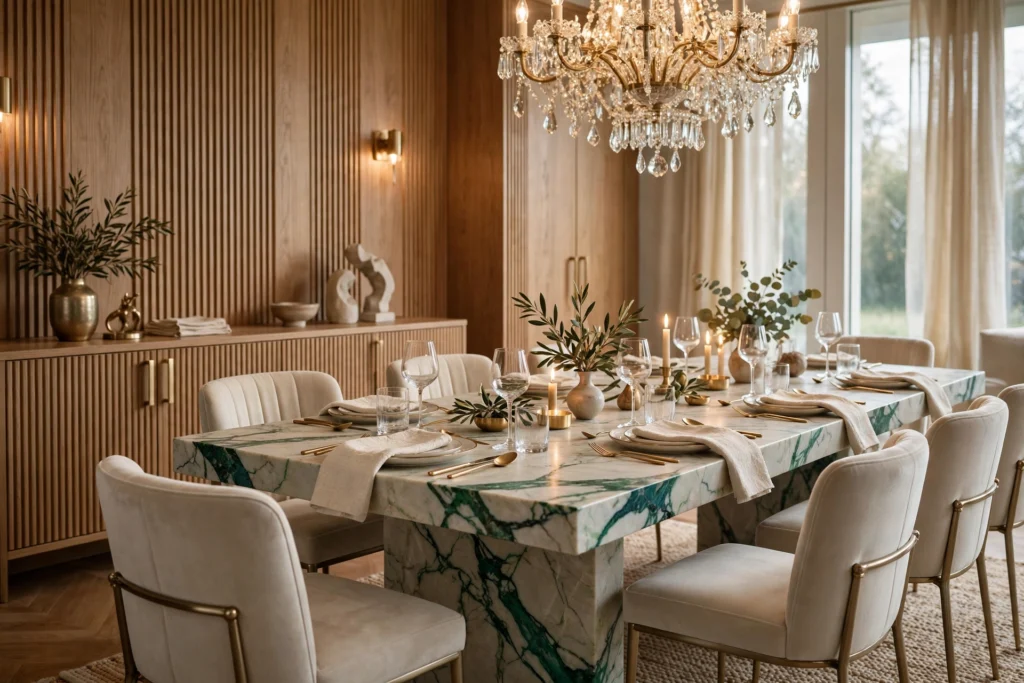
1. The Sculptural Stone Table
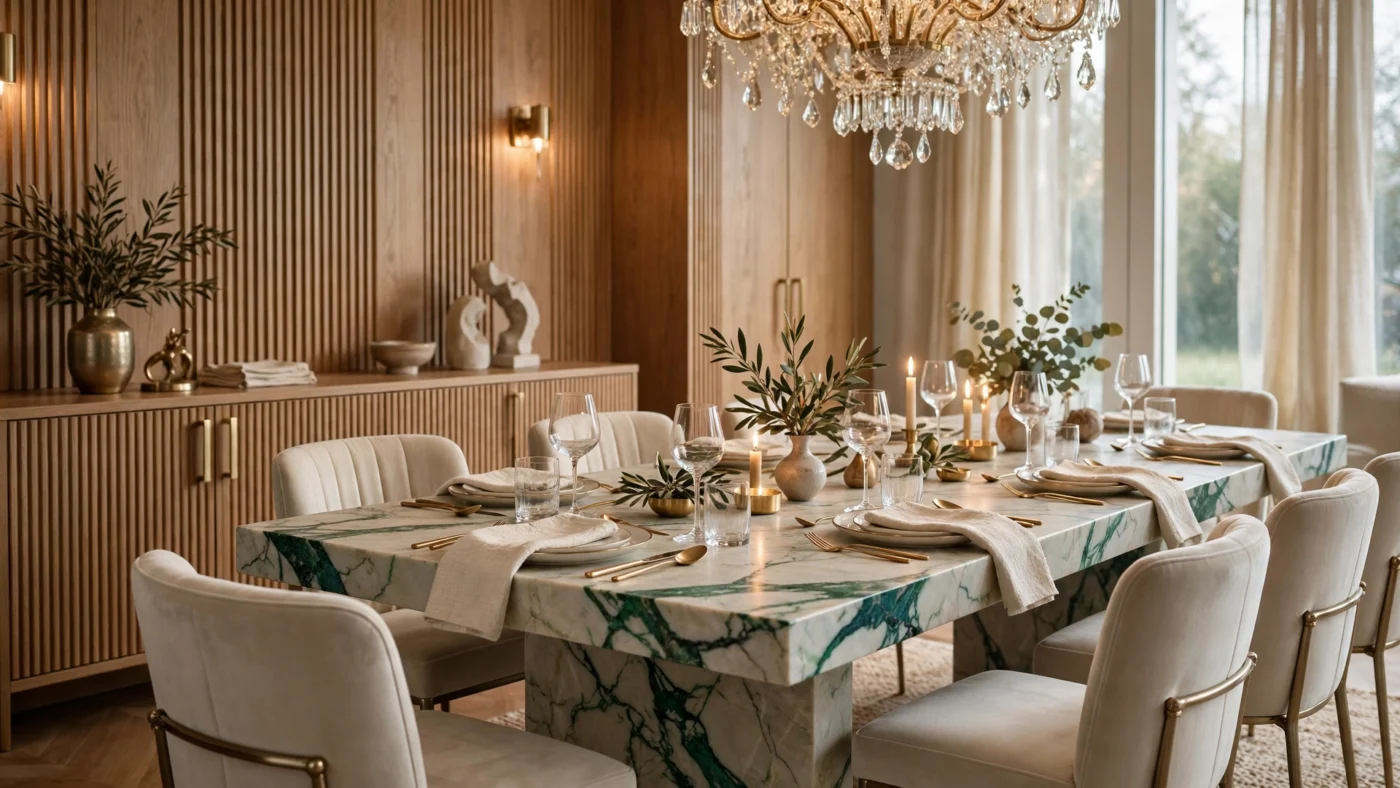
Replace the ordinary rectangle with a honed travertine, marble, or cast-stone table with a pedestal or monolithic base. Stone anchors the room visually and acoustically — it absorbs the clatter that makes hard-surfaced dining rooms echo. Keep the edges soft: rounded corners read modern-luxe, sharp ones read corporate.
2. The Statement Chandelier, Dimmed Warm
One great light over the table beats five mediocre ones. Size it to the table: the fixture’s diameter should be about one-half to two-thirds of the table’s width, and it should hang 30 to 36 inches above the tabletop. Choose dim-to-warm so it drops from crisp white to candle-amber as the evening goes on. Check your exact numbers with our chandelier size calculator before you buy.
3. Fluted Wood Panelling
The fastest way to make a dining room feel designed: texture on one wall. Fluted oak slats, painted panelling, or limewash plaster turn a flat box into a room with depth — no renovation required. Keep the other walls calm so the texture wall stays the hero.
4. The Curved Banquette
A built-in curved banquette along one wall seats more people in less space than chairs, softens a rectangular room, and photographs beautifully. Upholster it in performance velvet or leather so it survives real life. Pair with a round or oval table to complete the curve story.
5. The Emerald Marble Moment
Deep green marble with gold veining — as a tabletop, a sideboard top, or even one statement wall — is the material story of 2026. It reads rich without shouting, pairs with brass and candlelight, and works in both contemporary and traditional rooms. One surface is enough; marble everywhere becomes a showroom.
6. Gallery-Scale Art
One oversized piece beats a cluster of small frames. Go big — art that spans two-thirds of the sideboard’s width, hung so its centre sits about 57 to 60 inches from the floor. A picture light above it (200 to 400 lumens, warm white) makes the art glow after dark and doubles as accent lighting.
7. Layered Evening Lighting
The chandelier is the star; sconces and buffet lamps are the supporting cast. Flank a sideboard with two small table lamps, add dimmable wall sconces for wash, and let the chandelier dim to nearly nothing for candlelit dinners. Three layers, each on its own dimmer — that is the whole secret of restaurant lighting, at home.
8. The Right Rug, Sized Once
A dining rug must extend at least 24 inches beyond the table on every side so chairs stay on it when pushed back. Too small is the most common dining room mistake in existence — it makes the whole room look apologetic. Measure once with our rug size calculator. Low-pile wool or performance fibres slide chairs smoothly and survive spills.
9. The Quiet-Luxury Palette
Creamy walls, pale oak or chevron wood floors, upholstered chairs with piping — then exactly one bold note: an emerald chair pair, a brass fixture, a dark stone top. Restraint with one exclamation mark is the definition of quiet luxury. Everything matching everything is a furniture store, not a design.
10. The Mirrored Wall
A large mirror on the wall opposite the window doubles daylight and candlelight, and visually doubles the room. In a dining room it has a second job: diners see the table’s glow reflected back, which is why restaurants have used mirrors for a century. Keep the frame slim — brass or black — so the mirror reads as architecture, not decoration.
11. The Living Centerpiece
Skip the tall arrangement that blocks faces across the table. Luxury centerpieces in 2026 are low and alive: a stone bowl of moss and orchids, a row of small bud vases, a sculptural branch in a heavy vase. Diners should see each other, not foliage. Change it seasonally — the cheapest refresh in the room.
12. Zoning the Open Plan
In open-plan homes the dining area needs definition without walls. Do it with three moves: the rug sets the boundary, the chandelier marks the centre, and a low sideboard or console draws the line against the living zone. Keep sight lines open below 42 inches so the space still breathes.
With the 12 looks covered, these luxury dining room design ideas come down to execution — starting with the exact sizing rules designers use.
Dining Room Sizing Rules That Actually Matter
- Table clearance: leave 36 to 48 inches between the table edge and the wall (or nearest furniture) so chairs pull out and people walk behind seated diners.
- Width per diner: allow 24 inches of table width per person, 30 for true comfort. A 72-inch table seats six; stretch to eight with an extension leaf.
- Chandelier height: 30 to 36 inches above the tabletop. Higher and the light floats away; lower and tall guests meet the fixture.
- Chandelier width: one-half to two-thirds of the table width. For a 48-inch-wide table, a 24 to 32-inch fixture. Verify with our chandelier size calculator.
- Rug: table plus 24 inches each side, minimum. For a 40×72-inch table, that is roughly an 8×10-foot rug.
- Sideboard depth: 16 to 20 inches keeps it slim against the wall while holding serving pieces.
With sizing locked in, these luxury dining room design ideas turn to the element that makes or breaks the room: light.
The Luxury Dining Room Lighting Plan
Dining light has one non-negotiable job: make food and faces look good. That means warm light (2700K), dimmable, and layered. The plan:
- Over the table: the chandelier or a linear pendant, dim-to-warm, sized to the table. This is the layer you dim the most.
- Perimeter: dimmable sconces or picture lights on the walls — they wash the room in glow so the chandelier is not a lonely spotlight.
- Sideboard: two small lamps or one sculptural lamp at 200 to 400 lumens. They make the serving area feel styled, not utilitarian.
- Candles: real or LED — the final 5% that no fixture delivers. Unscented at the table; scented candles fight the food.
These luxury dining room design ideas treat light as a material — 2700K, dimmable, and layered is the whole formula.
Avoid cool-white bulbs entirely in a dining room. 4000K over dinner makes everyone look tired and the food look flat.
Lighting sets the mood, but these luxury dining room design ideas are built on materials — here’s what reads expensive.
Materials That Read Expensive
Luxury in a dining room is mostly a materials decision. The combinations that consistently read high-end in 2026:
- Stone + brass: honed marble or travertine with brushed brass fixtures — the warmest classic.
- Dark wood + bouclé: walnut or smoked oak with nubby upholstered chairs — modern, tactile, forgiving.
- Lacquer + mirror: high-gloss dark walls or sideboard with mirror — dramatic, best in rooms with good daylight.
- Plaster + linen: limewash walls with linen-upholstered seating — soft, calm, Mediterranean-leaning.
Mix at least three textures in every dining room — stone, wood, and something soft. Two textures is flat; four is rich; five needs an editor.
With materials sorted, these luxury dining room design ideas are almost foolproof — almost. Here are the mistakes that undo them.
Five Mistakes That Cheapen a Dining Room
- A rug that is too small. Chairs half-on, half-off the rug is the single most common dining room error. Size it once, properly.
- The builder-grade flush mount. One anonymous ceiling light says “apartment.” The chandelier is the room’s jewellery — budget for it.
- Pushing the table against the wall. Unless the room is genuinely tiny, float the table. Walls are for sideboards.
- Cool-white bulbs. Covered above — 2700K or nothing.
- Cluttered surfaces. A luxury dining room keeps the table and sideboard mostly clear between meals. One centerpiece, one lamp pair, done.
Avoid those mistakes and these luxury dining room design ideas practically implement themselves — here are the questions readers ask most.
Luxury Dining Room FAQs
What makes a dining room look luxurious?
Three things: one statement piece (stone table or chandelier), layered warm lighting on dimmers, and restraint — fewer, better pieces with room to breathe. Luxury is space and light, not quantity.
How big should a chandelier be over a dining table?
The fixture should be one-half to two-thirds as wide as the table, hung 30 to 36 inches above the tabletop. Use our chandelier size calculator to get exact numbers for your table.
What size rug goes under a dining table?
The rug must extend at least 24 inches beyond the table on all sides so chairs remain on it when pushed back. For a standard 40×72-inch table, that means roughly an 8×10-foot rug.
What color temperature is best for dining rooms?
2700K warm white, always dimmable. It flatters skin tones and food. Dim-to-warm fixtures that drop toward 2200K at low settings give the most candlelit feel.
How do I make a small dining room feel luxurious?
A round pedestal table (no corner legs to bump), a mirror to double the light, one statement pendant instead of a big chandelier, and a banquette to seat more in less space. Keep the palette light and the surfaces clear.
Whether your space is compact or grand, these luxury dining room design ideas adapt — proportion, light, and restraint are universal.
For more whole-home ideas, see our luxury walk-in closet guide and modern luxury living room ideas — the same principles of proportion, light, and restraint run through every room.