Luxury Espresso Machine: The Ultimate Buying Guide
There is a small, daily ritual at the heart of every great morning: the grind, the tamp, the first dark stream of espresso falling into a warm cup. A luxury espresso machine does not just make coffee. It turns that ritual into something you look forward to — a few quiet minutes that feel considered, sensory, and entirely yours.
This guide covers what actually makes an espresso machine “luxury” rather than merely expensive, how to think about design and materials, what to look for before you buy, and how to care for the machine so it serves you beautifully for years.
What Makes an Espresso Machine Truly “Luxury”?
The word luxury gets attached to espresso machines easily — usually by price alone. But price and luxury are not the same thing. Here is what separates a genuinely luxurious machine from a competent one with a big number on it.
Commercial-grade engineering, sized for home
Luxury machines borrow their hearts from café equipment: heavy boilers, solid brass group heads, and plumbing built to hold temperature steady shot after shot. The difference you taste is consistency. A cheap machine can pull one good shot on a lucky morning; a luxury machine pulls the same excellent shot on Tuesday, in a hurry, half-awake. That reliability is the engineering you are paying for.
Materials you can feel
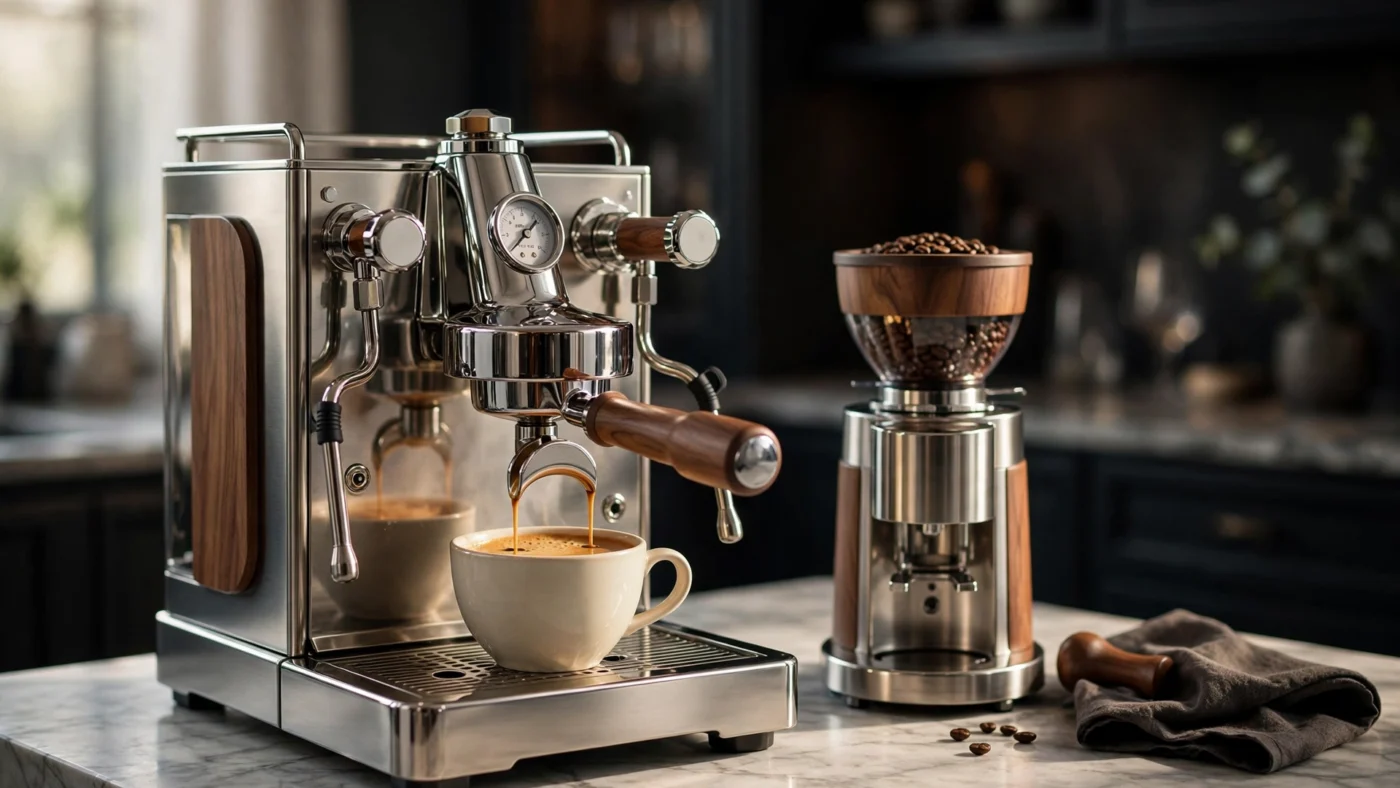
Pick up the portafilter of a luxury machine and you will know immediately. Stainless steel housings with real heft, chrome or powder-coated panels that do not flex, wooden or metal accents instead of plastic. Luxury machines are built like instruments, not appliances — and like instruments, they are designed to be serviced and kept for decades, not replaced.
Design that earns its place on the counter
Here is the angle almost nobody talks about, and it matters enormously in a luxury home. An espresso machine is the one kitchen appliance that stays on display. The luxury machines worth owning look like they were designed, not just engineered: considered proportions, beautiful finishes, details like analog gauges or walnut handles that make you glad to see it every morning. A machine that clashes with your kitchen will irritate you daily; one that belongs there becomes part of the room.
Control without complication
The best luxury machines give you meaningful control — over temperature, pre-infusion, pressure — without turning your morning into an engineering project. Look for thoughtful touches: a gauge you can actually read at a glance, controls that fall naturally under your hand, a steam wand with enough power and range of motion to texture milk properly. Luxury is control that feels effortless.
The Design Angle: Your Machine as Kitchen Sculpture
Because it lives on the counter, choose your machine the way you would choose a piece of furniture. A few design considerations that get overlooked:
- Finish and the rest of your kitchen. Polished stainless suits a modern kitchen; matte black or custom colors suit something moodier; wood accents warm up a minimalist space. Some makers offer custom finishes — worth exploring if the machine will anchor a designed kitchen.
- Footprint and height. Measure twice. Luxury machines are often deeper and taller than they look in photos, and they need clearance above for the cup warmer and behind for water access. A machine that crowds the backsplash looks stressed, not luxurious.
- The whole station, not just the machine. The most beautiful setups pair the machine with a matching or complementary grinder, a knock box that does not look like an afterthought, and a small tray or mat that defines the coffee corner. Think of it as a vignette, the way you would style a bar cart.
- Plumb-in versus reservoir. Machines that can be plumbed directly to a water line are the true luxury move — no refilling, no drip tray overflow mid-morning. It requires planning (and a plumber), but it transforms daily use.
Our guide to premium kitchen gadgets for modern homes covers how statement pieces like this fit into a considered kitchen overall.
What to Look For Before You Buy
Use this checklist when comparing machines. It cuts through marketing quickly.
- Temperature stability. The single most important performance factor. Machines with proper boiler design and temperature control produce consistent shots; machines without it do not, whatever their price.
- Build quality. Metal housings, solid-feeling controls, a portafilter with real weight. Open the drip tray and look at the fit and finish of the parts you cannot see in photos.
- Steam power. If you drink milk-based drinks, the steam wand matters as much as the espresso. It should be powerful enough to texture milk quickly and long enough to reach into a proper pitcher.
- The grinder question. A luxury machine deserves a grinder of matching quality — many enthusiasts will tell you the grinder matters more than the machine. Budget for both, or choose a machine from a maker whose grinders are equally respected.
- Water quality. Hard water is the enemy of fine espresso machines. Plan for filtered water from day one, whether through a plumbed filter or a careful routine with the reservoir.
- Service and parts. Luxury machines are built to be repaired, not replaced. Before buying, check that parts and qualified service exist where you live. A beautiful machine with no service network is a future paperweight.
- Your actual routine. Be honest: how many drinks do you make a day? A dual-boiler machine that heats for twenty minutes suits someone who makes four drinks every morning; it is overkill for one weekend cappuccino. Match the machine to the ritual.
Setting Up Your Luxury Espresso Corner
The machine is half the experience. The corner around it is the other half.
- Give it a dedicated home. A specific stretch of counter, near the sink, with an outlet that is not shared with the toaster. Rituals need a stage.
- Pair the grinder properly. Place it beside the machine at a comfortable working height. The grinder-to-machine distance should be short — coffee grounds lose aroma fast, so the workflow should be grind, tamp, brew, with no wandering.
- Add the small tools. A proper tamper, a distribution tool if you like one, a knock box, a milk pitcher that feels good in your hand, and a cloth kept only for the steam wand. These small objects are where the ritual lives.
- Warm your cups. The cup warmer on top of the machine exists for a reason. A hot shot in a cold cup is a compromised drink; keeping cups warm is free and makes a real difference.
- Keep it beautiful. Wipe the machine down after use. A luxury machine that is always clean looks like part of the kitchen’s design; one with dried milk on the wand does not, whatever it cost.
Caring for a Luxury Espresso Machine
A well-made machine will outlast trends, fashions, and probably your kitchen renovation — if you maintain it. The routine is simple but non-negotiable:
- Daily: backflush with water, wipe the steam wand immediately after every use, empty the drip tray, and leave the machine clean.
- Regularly: clean with proper espresso-machine detergent on the schedule the manual suggests, replace water filters on time, and descale only as the maker recommends (with soft, filtered water, descaling is rarely needed).
- Yearly: have it serviced by a qualified technician — gaskets, seals, and valves wear, and a service keeps everything within spec.
This is the unglamorous truth about luxury equipment of every kind: the luxury is in the maintenance. A serviced machine pulls better shots at year ten than a neglected one does at year two.
Frequently Asked Questions
How much does a luxury espresso machine cost?
Luxury espresso machines span a wide range, from serious home machines that cost as much as a good sofa to flagship models priced like a used car. Rather than fixating on a number, set your budget by tier: decide whether you want an excellent home machine, a prosumer machine with café DNA, or a true flagship. Then buy the best-regarded machine in that tier — stretching into a tier above usually buys more complexity, not more enjoyment.
What is the difference between a prosumer and a luxury espresso machine?
The terms overlap heavily. “Prosumer” usually describes performance — café-grade internals in a home-sized machine. “Luxury” adds the rest: materials, finish, design, and the experience of ownership. A prosumer machine can be a luxury machine when it is beautifully made and a pleasure to live with; a machine that performs well but feels cheap in the hand is neither.
Do I need a separate grinder?
Yes — and this is the advice most buyers resist and later wish they had taken. Pre-ground coffee goes stale within minutes of grinding, and no machine, however fine, can make great espresso from stale grounds. A quality grinder matched to your machine is not an accessory; it is half the system.
How long does a luxury espresso machine last?
A well-built machine that is maintained properly can last decades — there are machines from the 1990s still pulling excellent shots today. Longevity is one of the real arguments for buying luxury here: you are buying something designed to be serviced and kept, unlike appliances built for a five-year replacement cycle.
Is a luxury espresso machine worth it compared to a café habit?
Do the honest math on your own routine: the cost of your daily café drinks over a few years, against the machine, grinder, and coffee. For a daily drinker, the numbers usually favor home brewing surprisingly fast. But the real return is not financial — it is the ritual itself, the skill you build, and the quiet pleasure of making something excellent with your own hands every morning. If you want the broader picture on statement kitchen pieces, see our designer tech accessories guide and stylish technology that belongs in a luxury home.
The Bottom Line
A luxury espresso machine is one of the rare purchases where the luxury is not in showing it off but in using it — twice a day, every day, for years. Buy for build quality and temperature stability first, for design and materials second, and for the ritual the whole station creates. Choose a machine that belongs in your kitchen, pair it with a grinder that deserves it, maintain it like the instrument it is, and your mornings will never be quite the same. That is what the money is really for.