Luxury Air Purifier: The 2026 Buying Guide
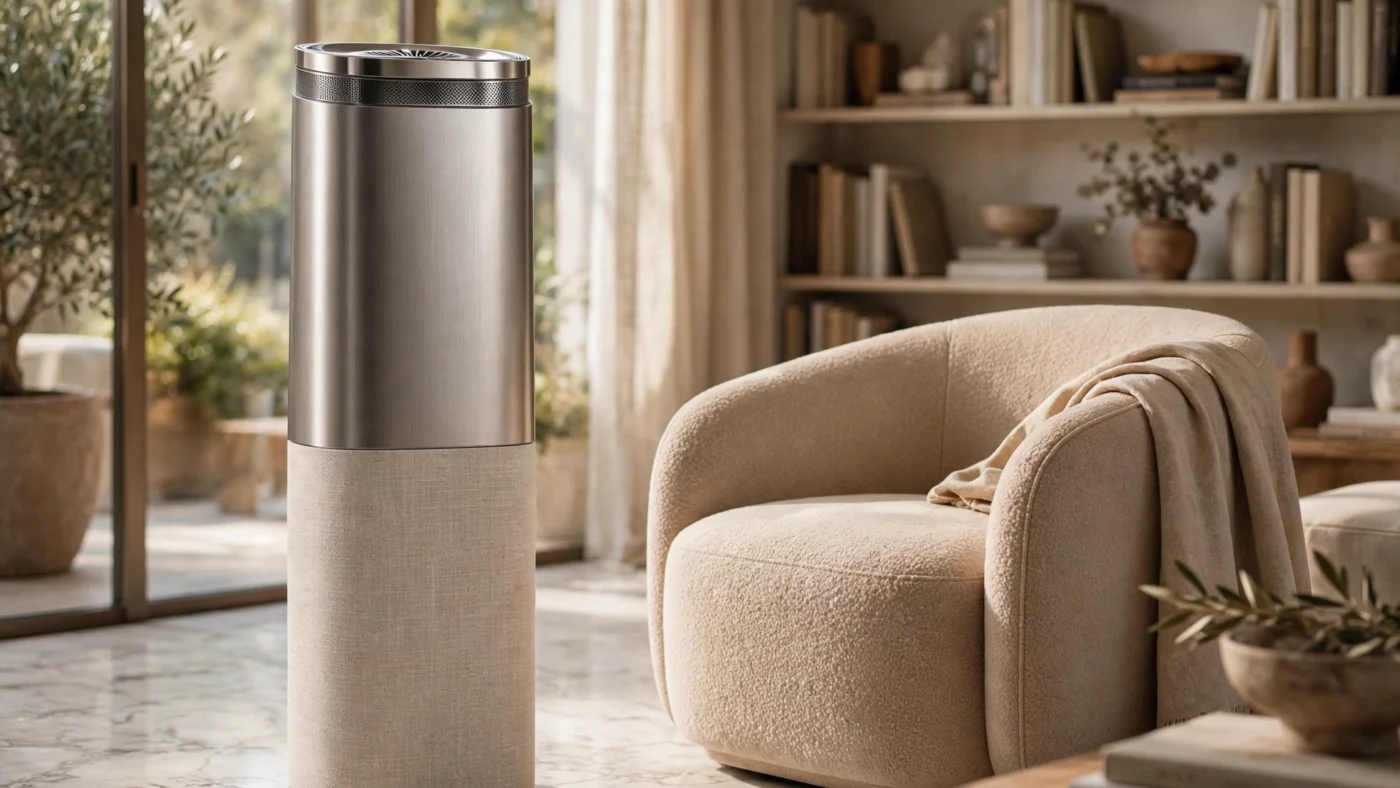
Most air purifier guides are written for people buying a $90 box to hide behind a sofa. This luxury air purifier buying guide is not. A luxury air purifier lives in the open — it must clean the air and elevate the room.
That second job is where almost every ranking article fails. They compare CADR numbers and call it a day, ignoring noise, design, filtration nuance, and the true cost of ownership. This luxury air purifier guide covers all of it.
What Actually Makes an Air Purifier “Luxury”
Forget marketing labels. A luxury air purifier earns the title on five criteria:
- Filtration that exceeds the baseline. True HEPA — capturing 99.97% of particles at 0.3 microns — is the floor, not the ceiling. Premium machines push beyond with denser media, larger filter banks, or formaldehyde-destruction systems.
- Silence. In a luxury home, a purifier that drones at 50 decibels is a failed purchase no matter how well it filters. The best machines run their sleep modes in the low 20s dB — quieter than a whisper.
- Design you don’t hide. Furniture-grade materials, considered proportions, finishes that match interiors — these separate luxury machines from plastic boxes.
- Intelligence. Real-time air quality sensing, auto-adjusting fan speeds, app control, and filter-life tracking that works.
- Honest long-term economics. Premium machines often have longer filter lives, which changes the real cost dramatically.
Step 1: Match CADR to Your Room (The Only Spec That Truly Matters)
CADR — Clean Air Delivery Rate — measures how much filtered air a purifier delivers per minute, tested independently by AHAM. It is the one spec you cannot afford to ignore, because an undersized luxury air purifier simply will not clean its room. The EPA’s Guide to Air Cleaners in the Home is a useful independent reference on CADR and filter types.
The rule of thumb: the purifier’s CADR should be at least two-thirds of your room’s square footage. For a 300 sq ft bedroom, you want a CADR of 200 or higher. For a 600 sq ft great room, you need 400+.
Luxury homes complicate this in two ways. First, open-plan living spaces are large — a single compact unit rated for 200 sq ft will struggle in a 500 sq ft great room no matter how premium it is. Second, high ceilings increase the actual air volume: a 300 sq ft room with 12-foot ceilings holds 50% more air than the same footprint with 8-foot ceilings. Size up one tier when ceilings run high.
This is the mistake the generic guides make: they recommend the same compact bestsellers for every room. In a luxury interior with generous proportions, those picks are undersized from day one.
Step 2: Understand Filtration Tiers
Not all “HEPA” is equal, and the terminology is deliberately confusing:
- True HEPA / HEPA-13: captures 99.97% of particles at 0.3 microns — dust, pollen, pet dander, most mold spores. This is the legitimate baseline.
- HEPA-type / HEPA-like: marketing terms with no standard behind them. Treat these as a red flag in any machine calling itself premium.
- HyperHEPA and beyond: the top tier, with manufacturers claiming capture rates like 99.995% down to 0.003 microns. Swiss-made machines like the IQAir HealthPro line built their reputations here.
- Activated carbon stages: essential if odors, cooking smells, smoke, or VOCs (from new furniture, paint, or flooring) matter to you. Particle filtration alone does nothing for gases and smells.
- Formaldehyde destruction: newer premium machines, notably Dyson’s Big+Quiet Formaldehyde line, add catalytic systems that continuously break down formaldehyde — relevant in homes with new cabinetry, flooring, or furnishings off-gassing VOCs.
For most luxury air purifier buyers, the right answer is True HEPA plus a substantial activated carbon stage. The rest is about your specific pollutants.
Step 3: Demand Real Quiet
Here is a number that matters more than CADR in daily life: the sleep-mode noise level. Published guides bury it; you should lead with it.
- Below 25 dB: effectively silent. Suitable for a master bedroom.
- 25–35 dB: a soft hum. Fine for living areas, noticeable in a quiet bedroom.
- Above 45 dB: conversation-level noise. Unacceptable in any room where you relax or sleep.
The catch: many machines achieve their headline CADR only at maximum fan speed — which is also their loudest. Published guides rarely tell you this. Premium machines earn their price partly here: larger fans running slower move the same air more quietly than small fans screaming at full tilt. When comparing any luxury air purifier, always check the noise figure at the speed that delivers its rated CADR.
Step 4: Judge It as Furniture
A luxury air purifier sits in your living room. It will be seen by every guest. So judge it the way you would any visible object:
- Materials. Brushed metal, fabric wraps, and matte finishes age gracefully. Glossy plastic shows dust and fingerprints within a week.
- Proportions. Tall, slim towers tuck beside furniture. Wide boxes dominate a room. Measure your intended spot before buying.
- Display lights. Bright LED displays and glowing rings are the enemy of a dark bedroom. Look for display-off or dimming modes — or at minimum, lights that can be disabled.
- Placement flexibility. Purifiers need breathing room — typically 1–2 feet of clearance on intake sides. A beautiful machine crammed into a corner where it cannot draw air is a sculpture, not an appliance.
Some manufacturers now design explicitly for visibility: Blueair’s Blue Signature line, for example, is styled as a furniture piece with wood-leg and chrome-disc options and can even serve as a tabletop surface. That is the direction the premium market is moving — machines designed to be seen.
Step 5: Calculate the 5-Year Cost, Not the Sticker Price
This is where a luxury air purifier often wins, and where cheap guides mislead. The purchase price is only the down payment:
- Replacement filters. A budget machine with $40 filters replaced every 6 months costs $400 in filters over 5 years. A premium machine with a $200 filter set lasting 2 years costs $500 — closer than the sticker prices suggest. And some premium machines, like Austin Air’s, stretch filter life up to 5 years, which can make them cheaper to run than mid-range rivals.
- Energy. Purifiers run for hours daily. Check the wattage at your typical speed, not just the maximum. ENERGY STAR-rated models publish this clearly.
- Your time. Machines with washable pre-filters and honest filter-life indicators save the fiddliest maintenance.
Before buying a luxury air purifier, look up the replacement filter price and rated life, then do the five-year math. It takes ten minutes and often reverses the apparent ranking.
The Premium Shortlist: What Each Tier Does Best
Rather than a ranked list of affiliate links, here is how the luxury air purifier landscape actually breaks down in 2026:
- Maximum filtration: Swiss-engineered machines with HyperHEPA-class media (IQAir HealthPro series) remain the reference for raw particle capture, paired with WiFi control and repairable, long-life construction.
- Formaldehyde and smart design: Dyson’s Big+Quiet line targets chemical pollutants with catalytic formaldehyde destruction, very long filter intervals, and the brand’s distinctive bladeless aesthetic.
- Designed to be seen: Blueair’s furniture-grade models prioritize interior integration — pieces you place deliberately rather than hide.
- Large-space workhorses: Coway’s Airmega series covers big rooms and open plans with strong CADR, quiet operation, and long warranties — the practical luxury choice for great rooms.
- Set-and-forget longevity: Austin Air’s machines trade smart features for extreme filter life (up to 5 years) and steel construction — the buy-it-for-decades option.
Match the luxury air purifier tier to your priority: allergies, chemicals, aesthetics, room size, or longevity. No single machine leads on all five.
Placement: Where to Put It for Maximum Effect
Even the best purifier underperforms in the wrong spot:
- In the room you use most, not the hallway. Bedrooms and living rooms first.
- With clearance on intake sides — never flush against a wall or behind curtains.
- Away from the exact spot where pollutants are generated (not directly over the stove, for example) — give it room to circulate the whole space.
- Elevated slightly if possible; many machines perform best with unobstructed airflow at mid-room height rather than floor level in a corner.
One large, correctly placed luxury air purifier outperforms two small ones shoved into corners. Placement is free performance.
Frequently Asked Questions
What CADR do I need for a 400 sq ft living room?
Aim for a CADR of at least 265 (two-thirds of 400), and size up toward 350–400 if ceilings exceed 9 feet or the space is open-plan. An undersized luxury air purifier will run constantly at full speed — loud and ineffective.
Are expensive air purifiers worth it?
They can be, but not automatically. A luxury air purifier earns its price through quieter operation at effective speeds, better materials and design, longer filter life, and verified filtration. Do the 5-year ownership math before deciding — filter costs often narrow the gap.
How often do luxury air purifier filters need replacing?
It varies enormously: 6 months for some compact premium models, 1–2 years for most mid-premium machines, and up to 5 years for long-life designs like Austin Air. Always check the manufacturer’s rated filter life and the replacement filter price before buying.
Can an air purifier remove cooking odors and VOCs?
Only a luxury air purifier with a substantial activated carbon stage can remove odors and VOCs. HEPA filters capture particles, not gases or smells. For new furniture off-gassing or formaldehyde specifically, look for machines with dedicated VOC/formaldehyde systems.
Where should I place an air purifier in a bedroom?
Near the bed but with 1–2 feet of clearance on the intake sides, away from curtains. Prioritize a machine with a genuine sub-25 dB sleep mode — noise matters more than marginal CADR differences in a bedroom.
Shopping for more high-end home tech? Our guide to premium smart devices for modern living covers the connected home, stylish technology that belongs in a luxury home curates design-forward gadgets, and our luxury espresso machine buying guide applies the same no-hype method to another premium purchase.