Luxury Walk-In Closet Ideas: 13 Bespoke Designs for 2026
A walk-in closet is the most personal room in a luxury home. Nobody performs there — it is just you, your clothes, and the quiet ritual of getting dressed. In 2026, the best closets are designed like private boutiques: beautiful lighting, materials worth touching, and storage that treats a wardrobe as a collection. These luxury walk-in closet ideas will help you plan a space that feels bespoke, whether you are renovating a whole dressing room or upgrading a generous reach-in.
Plan the Layout Before You Buy Anything
Every great closet starts with measurements and zones, not shopping. Think of the closet as an extension of the primary suite — our luxury bedroom design ideas pair naturally with a considered dressing space. Map your space and divide it into three zones: hanging (roughly 60 percent of most wardrobes), shelving and drawers (30 percent), and display (10 percent for the pieces you love looking at — handbags, watches, a favorite pair of heels). The three classic layouts are single-wall (everything along one wall, best for narrow rooms), L-shaped (wraps a corner and doubles hanging space), and island (a central dresser or ottoman with storage on all sides, the true boutique feel, needs at least 3 by 3 meters to breathe). Sketch it on paper first. A closet planned on paper costs nothing to revise; a closet planned at the checkout does not.
13 Luxury Walk-In Closet Ideas for 2026
1. Install Glass-Front Wardrobes With Integrated Lighting
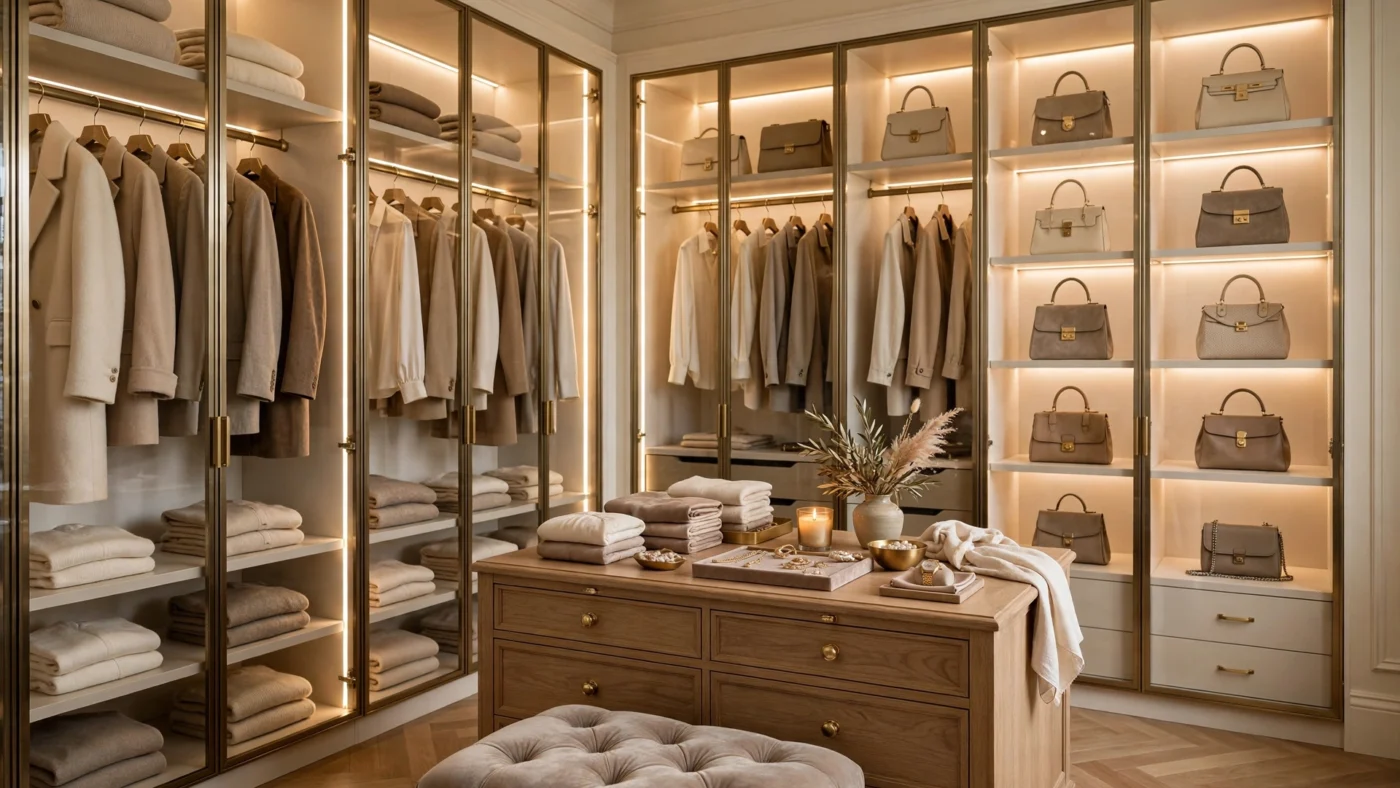
Glass-front cabinetry is the defining look of the 2026 luxury closet. It turns storage into display — your clothes become the decor — while keeping dust off everything. The key detail is integrated LED strips inside each cabinet, set to a warm 2700 to 3000K, so the wardrobe glows softly like a shop window. Choose low-iron glass for a clearer, less green-tinted view, and keep the frames slim in brass, bronze, or matte black.
2. Add a Center Island Dresser
If your floor plan allows, a center island is what separates a closet from a dressing room. Use it for folded knits, accessories, and jewelry — shallow drawers with velvet lining keep everything visible and protected. Top it with a tray for the watch you wear daily, a small vase, and a scented candle. The island also gives you a surface to lay out tomorrow’s outfit, which is a small daily luxury that never gets old.
3. Layer the Lighting Like a Boutique
Closets fail most often on lighting — one cold ceiling bulb that makes colors look wrong and corners disappear. Layer three types instead: ambient (a flush-mount or chandelier for overall glow), task (LED strips inside wardrobes and under shelves so you can actually see what you own), and accent (a picture light over art or a lit mirror). Warm light renders fabric colors accurately; cool light lies to you at 7 a.m.
4. Put Real Seating in the Room
A velvet ottoman, a small upholstered bench, or a sculptural chair changes how a closet feels and functions. You need somewhere to sit to put on shoes, and seating turns the room into a place you linger rather than rush through. Choose something with presence — a curved ottoman in boucle or velvet, or a vintage bench with good lines. It is the piece guests always comment on.
5. Display Handbags Like Art
Handbags deserve better than a crowded shelf. Give them open cubbies or a lit glass shelf at eye level, one bag per space, stuffed with tissue to hold their shape. This boutique-style display does two things: it protects structured bags from losing their silhouette, and it reminds you of what you own so pieces actually get worn. Rotate the display seasonally to keep it fresh.
6. Use Pull-Down Rods for High Hanging
High shelves waste the most valuable real estate in a closet — the full-height hanging zone. Pull-down wardrobe rods bring that upper rail down to you with a gentle tug, making floor-to-ceiling storage genuinely usable. They are especially worth it for long dresses, coats, and occasion wear that need uninterrupted hanging length. One pull-down rod can add the equivalent of an entire extra wardrobe rail.
7. Line Drawers With Velvet
The inside of a drawer is where luxury is felt rather than seen. Velvet-lined jewelry drawers with compartments for watches, rings, and sunglasses protect precious pieces from scratches and turn getting dressed into a ritual. Extend the idea: felt-lined tie drawers, divided belt drawers, and soft-lined sunglass trays. These details cost little during a renovation and deliver daily pleasure for years.
8. Cover One Wall in Mirror
A full-length mirror is non-negotiable; a mirrored wall is transformative. Floor-to-ceiling mirror on one wall doubles the light, doubles the sense of space, and lets you check an outfit from every angle without turning around. Frame it minimally or go frameless for a seamless look. If a full wall feels like too much, a pair of tall leaning mirrors in slim brass frames achieves most of the effect.
9. Build a Dedicated Shoe Wall
Shoes stored in boxes on the floor are shoes you forget — and boxes stacked in a luxury closet look like a storage unit. A dedicated shoe wall with slanted shelves displays each pair at a readable angle, keeps soles off your clothes, and makes choosing effortless. Angle the shelves slightly, add a slim LED strip above each row, and leave breathing room between pairs. Your future self, running late, will thank you.
10. Carve Out a Vanity Corner
The 2026 dressing room increasingly absorbs the vanity — a small desk with a mirror, good task lighting, and drawers for cosmetics turns the closet into a complete getting-ready suite. You do not need much space: 90 centimeters of counter, a comfortable stool that tucks underneath, and a mirror with flattering front light. It keeps the morning routine in one calm, beautiful room instead of scattered across the house.
11. Hang a Small Chandelier
Yes, in the closet. A small chandelier or sculptural pendant is the signature move that tells everyone this room was designed, not just fitted out. If your dressing room flows into an ensuite, our luxury bathroom design ideas will help you keep the material palette consistent across both spaces. Crystal, alabaster, or hand-blown glass all work — keep the scale modest so it reads as jewelry, not as a dining room fixture that wandered in. Put it on a dimmer; bright for choosing outfits, low and warm for atmosphere.
12. Commit to Warm, Tactile Materials
The material palette is what makes a closet feel like a boutique instead of a showroom. These are the kinds of timeless decor pieces worth investing in — materials and fixtures that look as good in ten years as they do today. Walnut or smoked oak cabinetry, brushed brass hardware, boucle or velvet seating, a soft wool rug underfoot — materials with warmth and texture. Avoid high-gloss white laminate everywhere; it reads as a kitchen, not a dressing room. Even in a small closet, one warm material (a wood island, brass rails) changes the entire feeling.
13. Finish With Scent and Art
The final layer is invisible: scent. A drawer sachet of cedar or lavender protects woolens from moths while making every opened drawer a pleasure; a subtle room diffuser with white tea or amber gives the space its own signature. Hang one piece of art — a fashion sketch, a black-and-white photograph — and the closet stops being storage and becomes a room with a point of view.
Storage Rules That Protect Luxury Fabrics
A beautiful closet that ruins clothes is a failure, so build these rules into the design. Never hang heavy knits — fold them, or the shoulders will stretch permanently. Give structured blazers and coats wide, shaped hangers; wire hangers distort shoulder lines over time. Keep direct sunlight off the wardrobe with lined curtains or UV-filtering glass, because light fades dark dyes faster than anything else. Leave air circulating — cramming rails full traps moisture, which is the enemy of fine wool, leather, and silk. And store handbags stuffed and upright, never stacked, so they keep their shape for decades.
5 Mistakes That Ruin a Walk-In Closet
- Designing for the clothes you wish you owned. Count what you actually have — by category — before planning a single shelf. A closet built for fantasy wardrobes never fits real life.
- One cold overhead light. It makes colors lie and corners vanish. Layer warm ambient, task, and accent lighting instead.
- Deep shelves with no dividers. Anything deeper than 40 centimeters becomes a cave where clothes go to disappear. Add dividers or pull-out trays.
- Forgetting a full-length mirror. Checking an outfit in the bathroom mirror after dressing in the closet is a daily friction a luxury space should never have.
- No seating. A closet without somewhere to sit is a corridor with shelves. Even a small ottoman changes the room.
Frequently Asked Questions
How much space do you need for a walk-in closet?
A comfortable walk-in starts around 2 by 2 meters for a single-wall or L-shaped layout. For the full boutique experience with a center island, aim for at least 3 by 3 meters so there is 90 to 100 centimeters of clear walkway around the island. Below that, an island will make the room feel cramped rather than luxurious.
What is the best lighting for a walk-in closet?
Warm white light between 2700 and 3000K renders fabric colors most accurately. Combine a central ambient fixture with LED strips inside wardrobes and under shelves, plus a flattering front light at the mirror or vanity. Avoid cool daylight bulbs — they make warm fabrics look dull and skin look tired.
How do I organize a walk-in closet like a boutique?
Think in zones: group by category (all blazers together, all dresses together) rather than by color alone, face everything the same direction, leave breathing room between pieces, and display a few hero items — handbags, watches, statement shoes — at eye level like a shop window. Edit ruthlessly; boutiques never look crowded.
What materials look most luxurious in a closet?
Walnut and smoked oak for cabinetry, brushed brass or bronze for hardware and rails, velvet or boucle for seating, and wool or silk-look rugs underfoot. Glass fronts with slim metal frames keep the look light. The common thread is warmth and tactility — materials that look good and feel good to touch.
How can I make a small closet feel luxurious?
Focus on light, mirrors, and editing. LED strips inside a small wardrobe make it feel custom; a mirrored door doubles the sense of space; and a ruthless edit — keeping only what fits, flatters, and gets worn — makes any closet feel curated. One beautiful detail, like velvet-lined drawers or brass hardware, elevates the whole room.
A luxury walk-in closet is not about having more clothes — it is about honoring the ones you have. Plan the layout around your real wardrobe, light it like the boutique it is, and choose materials that make the daily ritual of getting dressed feel like an occasion. That is what bespoke truly means.