Dining Room Chandelier Size: The 2026 Complete Guide
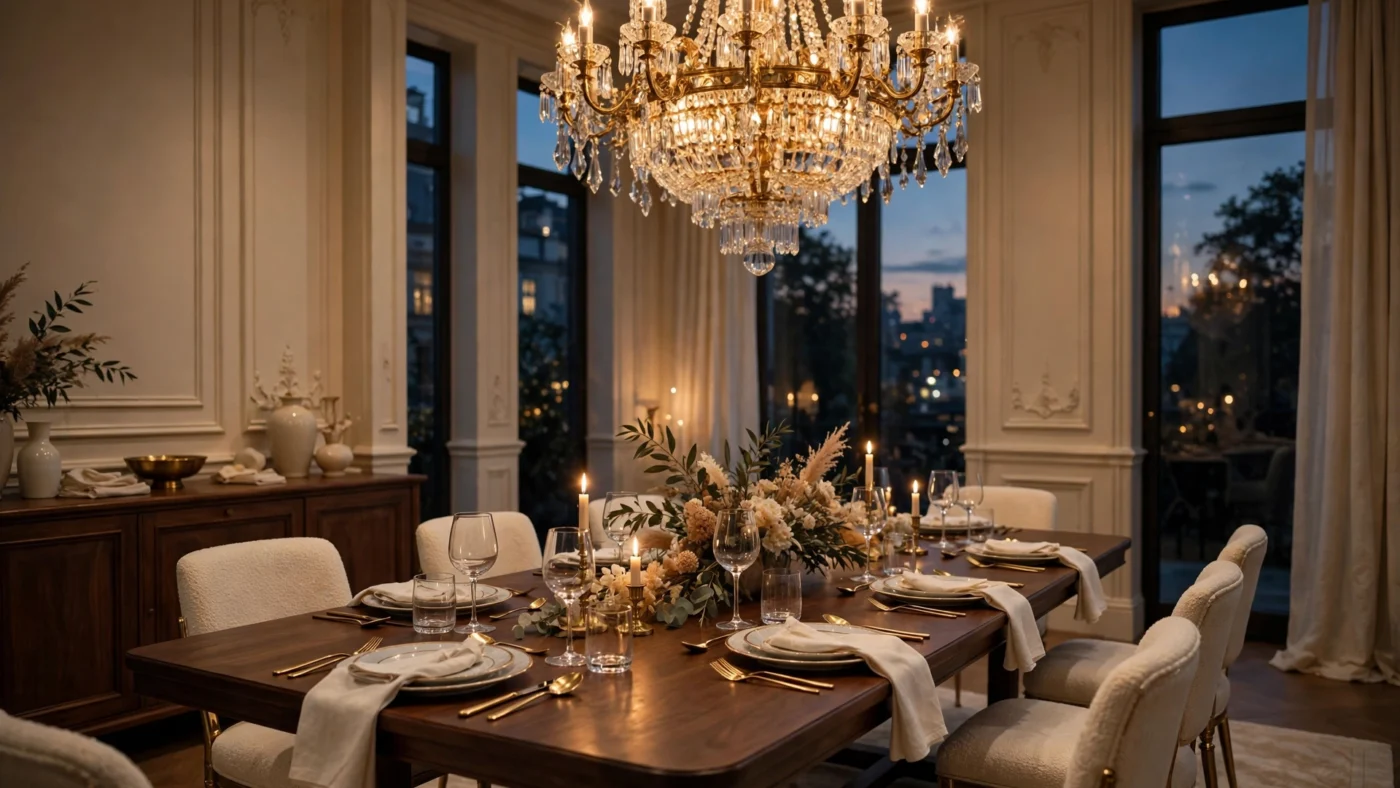
A dining room chandelier is the one light fixture in your home that everyone sees twice: once as a design object when they enter the room, and once as pure function when they sit at the table. Get the size right and the whole room feels finished. Get it wrong — too small, too high, the wrong shape — and no amount of expensive furniture will rescue it. This guide gives you the exact rules interior designers use to size and hang a dining room chandelier, with real numbers you can measure today. Pair these sizing rules with our luxury dining room design ideas for the full room plan.
The three rules that size any dining chandelier
Ignore the marketing. Sizing a dining chandelier comes down to three measurements: your table, your room, and your ceiling. Here’s each rule in plain numbers.
Rule 1: Size to the table — the 1/2 to 2/3 rule
The chandelier’s primary job is to anchor the dining table, so start here. Measure the width (for a rectangular table, the shorter side) or diameter (for a round table) of your table in inches. Your chandelier should be between one-half and two-thirds of that number. To get the exact figure for your fixture, run your measurements through our Chandelier Size Calculator.
- A 42-inch round table calls for a chandelier 21 to 28 inches across.
- A 60-inch rectangular table calls for a chandelier 30 to 40 inches across (or long, if linear).
- A 72-inch table works with a fixture 36 to 48 inches long — oval or linear shapes suit long tables best.
The lower end of the range reads restrained; the upper end reads confident and design-forward. When in doubt, size toward the upper end — an undersized chandelier is the single most common mistake in dining rooms, and it is far less forgiving than going slightly bold.
Rule 2: Size to the room — the length-plus-width rule
Measure your dining room’s length and width in feet, add them together, and treat that sum as inches of chandelier diameter. A 12 × 14-foot dining room suggests a chandelier around 26 inches wide. This rule keeps the fixture proportioned to the volume of the room, not just the table.
When the two rules disagree, follow the table rule. The chandelier hangs over the table, not the middle of the room — the table relationship is what the eye checks first.
Rule 3: Mind the ceiling height
Taller ceilings buy you two things: more vertical room for the fixture, and a need for more visual weight. A chandelier that looks perfect in an 8-foot-ceiling dining room will look lost under a 12-foot ceiling. If your ceiling is 10 feet or higher, lean toward the top of the sizing range and choose a taller, multi-tier fixture that can fill the vertical space.
Worked example: sizing for a 12 × 14-foot dining room
Let’s run the rules on a classic American dining room: 12 × 14 feet, a 72-inch rectangular table seating six, and a 9-foot ceiling.
- Table rule: 72 inches × 1/2 = 36 inches; 72 × 2/3 = 48 inches. Target: 36–48 inches.
- Room rule: 12 + 14 = 26 inches. This confirms the lower half of the table range is room-appropriate.
- Ceiling adjustment: 9 feet is one foot above standard, so lean toward the top: aim for a 40–48-inch oval or linear fixture.
- Shape: rectangular table, so choose an oval or linear chandelier that echoes the table’s footprint.
- Height: 9-foot ceiling — hang the bottom of the fixture about 33–36 inches above the tabletop (see the table below).
Run these numbers for your own room and you’ll arrive at a confident shortlist instead of guessing in a showroom.
Dining room chandelier hanging height, by ceiling
Width is only half the equation. A chandelier hung too high floats, disconnected from the table; hung too low, it blocks sightlines across the table and makes the room feel cramped. The industry-standard rule: the bottom of the fixture sits 30 to 36 inches above the tabletop for an 8-foot ceiling. Add roughly 3 inches of height for every additional foot of ceiling.
| Ceiling height | Hang height (bottom of fixture above tabletop) |
|---|---|
| 8 feet | 30–36 inches |
| 9 feet | 33–39 inches |
| 10 feet | 36–42 inches |
| 12 feet | 42–48 inches |
One safety caveat: in an open-plan layout where people walk under the fixture, the bottom must clear at least 7 feet above the floor, regardless of what the table math says. And always install the chandelier with a dimmer — a dining fixture at full brightness for every occasion is a design failure, not a feature.
Shape matching: echo your table
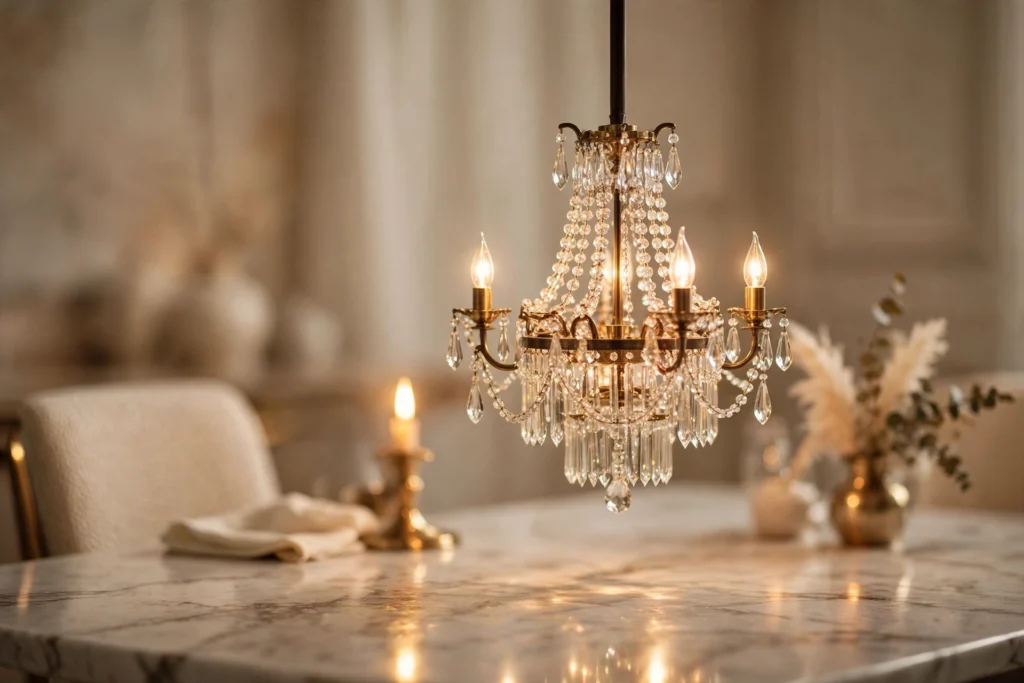
Shape does more quiet work than most people realize. A round fixture over a long rectangular table looks like an afterthought; a long linear fixture over a small round table looks like a bridge. The rule is simple: match the chandelier’s silhouette to the table’s silhouette. Round and square tables take round fixtures. Long tables take oval, rectangular, or linear fixtures. Tables over 10 feet long almost always look better with two matching chandeliers (or a matched pair of pendants) than with one oversized piece — two fixtures distribute light down the length of the table and read more intentional. And the fixture needs a table worthy of the match — start with a correctly sized dining table so the proportions work from the floor up.
How bright? Lumens for a luxury dining room
A chandelier is also a light source, so size its brightness too. A dining room needs roughly 30 to 40 lumens per square foot of dining area. For our worked example — a 12 × 14-foot room (168 square feet) — that’s 5,000 to 6,700 lumens total. Plan it in three layers: the chandelier as the task/ambient anchor over the table, plus recessed or wall lighting to lift the room’s edges so the chandelier isn’t doing all the work alone. Choose 2,700–3,000K color temperature for candlelight-warm dinners, and put every layer on a dimmer so one room can be a working breakfast table and a dramatic dinner setting.
Want the exact number for your room? Try the Luxury Lighting Calculator — enter your room’s dimensions and it calculates the lumens your dining room actually needs, so you can pick a chandelier bright enough to earn its place.
5 chandelier sizing mistakes that make dining rooms look cheap
- The floating 18-incher. A tiny chandelier over a big table is the most common sight in underwhelming dining rooms. It signals the fixture was a leftover, not a decision.
- Hung for the ceiling, not the table. Centering the fixture in the vertical void of a tall ceiling leaves it hovering uselessly above eye level. Hang to the table first.
- Ignoring the shape rule. A big round chandelier over a long narrow table throws light where nobody sits and looks unbalanced.
- Skipping the dimmer. A dining room needs at least two moods — task brightness and candlelight warmth. One brightness level is a hotel lobby, not a home.
- Forgetting the 6-inch rule. Leave at least 6 inches of bare table showing on each end of the fixture. If the chandelier overhangs the table’s edges, it looks top-heavy and risks head strikes.
Dining room chandelier size FAQs
Can a chandelier be wider than the dining table?
No — a chandelier should never be wider than the table it hangs over. Overhang creates visual imbalance and a real risk of head strikes. Stay within the one-half to two-thirds rule.
How many inches above the table should a chandelier hang?
30 to 36 inches above the tabletop for an 8-foot ceiling, adding about 3 inches per extra foot of ceiling height. In walk-under open plans, keep at least 7 feet of floor clearance.
What size chandelier for a 6-seat dining table?
A typical 6-seat table is 60–72 inches long, so a 36 to 48-inch oval or linear chandelier fits the 1/2–2/3 rule. Lean toward the top of the range for a luxury look.
How bright should a dining room chandelier be?
Plan the whole room for 30–40 lumens per square foot, with the chandelier as the anchor layer — roughly 5,000–6,700 lumens for a 12 × 14-foot room. Dimming is non-negotiable.
One chandelier or two over a long table?
For tables over 10 feet, two matching chandeliers (or a pair of pendants) beat one oversized fixture — better light distribution down the table’s length and a more intentional, designed look.