Luxury Wine Fridge: The 2026 Buying Guide
A luxury wine fridge is one of those purchases that separates a serious collector from someone who just likes wine. A regular refrigerator runs too cold, too dry, and vibrates enough to disturb sediment in every bottle. A proper wine fridge holds a steady 55 degrees, keeps humidity where corks survive, and sits silent enough for a dining room. This guide covers everything: how to size it, single versus dual zones, built-in versus freestanding, the noise spec nobody checks, and how to choose a unit that looks like furniture instead of an appliance.
Why a Wine Fridge, Not a Regular Refrigerator?
Four enemies kill wine in storage, and a standard fridge invites all of them:
- Wrong temperature. Kitchen fridges run at 35–38°F. Wine ages best around 55°F for long-term storage; reds serve best at 60–65°F, whites at 45–50°F. A kitchen fridge is a refrigerator, not a cellar.
- Too little humidity. Standard refrigerators are dehumidifiers. Dry air shrinks corks, which lets oxygen in and oxidizes the wine. Wine fridges target 50–70% humidity — the range that keeps corks swollen and sealing.
- Vibration. Compressor hum in a kitchen fridge agitates bottles continuously, disturbing sediment in aged reds and dulling their development. Wine fridges use vibration-damped compressors or thermoelectric cooling designed for stillness.
- Light. UV light breaks down wine compounds — “lightstrike” — which is why quality bottles use dark glass and quality wine fridges use UV-protected doors or solid doors.
How Many Bottles Will You Actually Store?
Capacity is the number-one regret point in wine fridge ownership. Buyers underestimate, then stack bottles on top within a year. Do the math before you shop:
- Count what you own today — every bottle you’d rather store properly.
- Add your buying habit. If you buy a case (12 bottles) a month and drink half of it, your collection grows by 6 bottles monthly — 72 a year.
- Double it. Collections expand to fill available space. The rule of thumb in the trade: buy a fridge rated for twice your current collection.
So 40 bottles today with moderate buying means a 100-bottle unit, not a 50. In built-in terms, that usually means a 24-inch wide column rather than an 18-inch one. Upgrading later costs more than sizing right once — the cabinetry gets built around the unit.
Single Zone vs. Dual Zone: Which Do You Need?
- Single zone holds one temperature throughout — typically set at 55°F for aging everything together. Best for: collectors who cellar long-term and serve at room or chilled from elsewhere. Simpler, more reliable, often cheaper per bottle.
- Dual zone splits the cabinet into two independently controlled compartments — say, 62°F on top for reds and 48°F below for whites. Best for: people who entertain, drink both reds and whites regularly, and want bottles at serving temperature on demand.
The honest luxury answer: if you host dinners, get dual zone. A single-zone unit means either your reds come out too cold or your whites come out too warm, and neither impresses at the table.
Built-In vs. Freestanding vs. Panel-Ready
This is where a wine fridge becomes a design decision, not just an appliance:
- Freestanding needs clearance on all sides to vent — typically several inches. Cheapest and easiest to relocate, but it always reads as an appliance.
- Built-in (front-venting) vents from the front, so it slides flush into cabinetry with zero side clearance. The standard for kitchens, bars, and dining rooms. Look for “zero-clearance” or “front-venting” in the spec sheet.
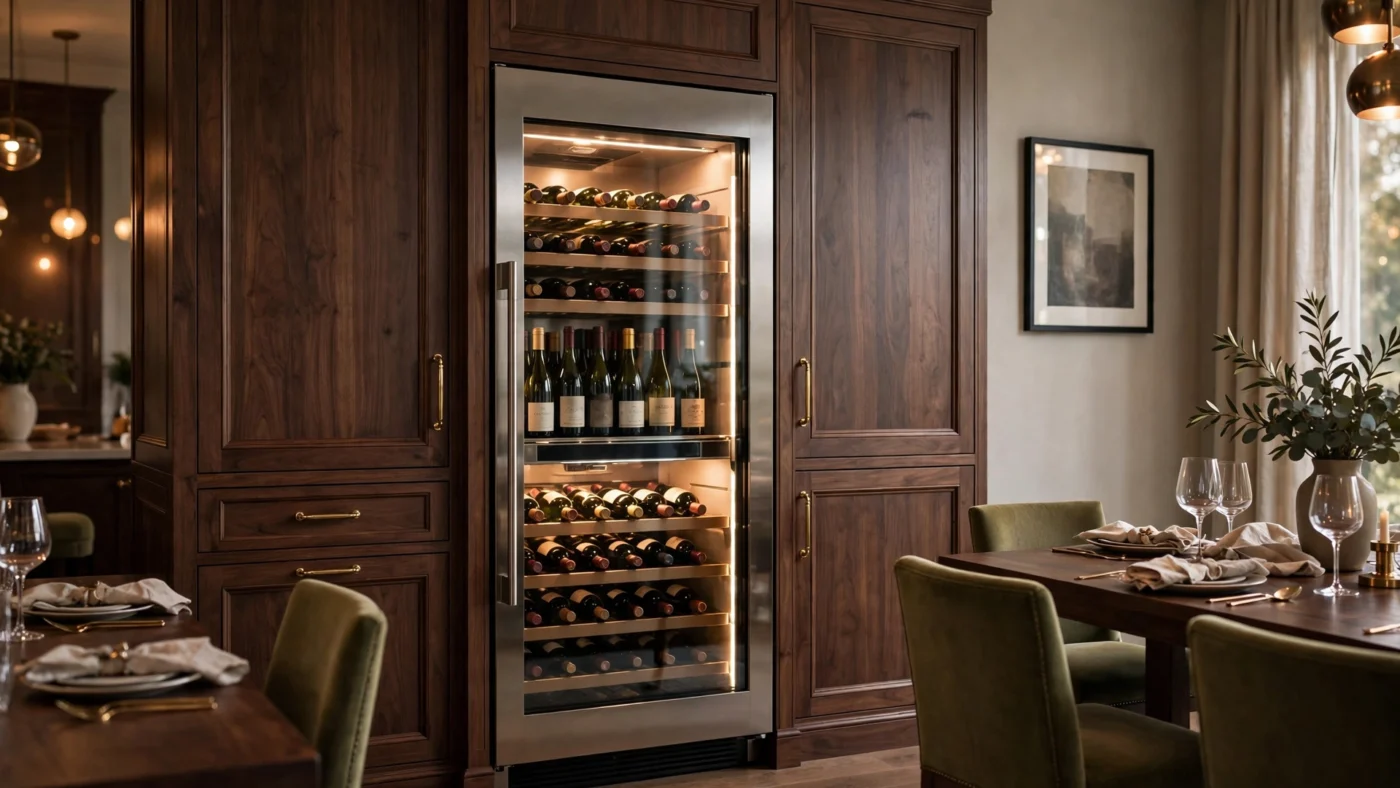
- Panel-ready accepts a custom cabinet panel on the door, so the fridge disappears into the millwork. The most invisible option — and the one high-end kitchen designers specify. Requires a cabinetmaker and precise dimensions, so finalize the model before the cabinetry is built.
One installation rule: never put a freestanding unit into a built-in cavity. It will overheat, the compressor will work itself to death, and the warranty won’t cover it.
The Quiet Spec Nobody Checks: Noise and Vibration
A wine fridge often lives where people eat, talk, and relax — so noise matters more than it does for a garage freezer. The numbers to compare:
- Under 40 dB is library-quiet — you won’t notice it in a dining room. Most premium compressor units land at 38–42 dB.
- Thermoelectric units are nearly silent but struggle in warm rooms and cap out at smaller capacities. Fine for 20–30 bottles in a climate-controlled room; not for a serious collection.
- Look for vibration damping — rubber-mounted compressors and decoupled shelving. Vibration isn’t just about noise; it disturbs sediment in aged wines.
If the spec sheet doesn’t list a decibel figure, treat that as a red flag. Every serious manufacturer publishes one.
The Luxury Shortlist: What to Look For
We’re not going to pretend every brand is equal. In the luxury tier, a few names recur in high-end kitchens for good reason:
- Sub-Zero. The benchmark for built-in wine storage — panel-ready, dual-zone options, furniture-grade build. The price reflects it, but so does the resale value of the kitchen.
- Eurocave. The French originator of the wine cabinet, still the connoisseur’s reference for long-term aging conditions. Solid-door “cellar” models are the choice for serious collectors.
- Liebherr. German engineering with excellent temperature stability and quiet operation — strong value inside the premium tier.
- Zephyr. Design-forward built-in units with Presrv technology, popular with kitchen designers for the clean, modern aesthetic.
- Kalamera. The accessible end of the luxury look — dual-zone, stainless, and smart-connected features without the four-figure-plus outlay.
Compare warranty terms as carefully as specs: compressor warranties of 5+ years are the mark of a manufacturer that expects its unit to last. Anything under 3 years at luxury prices is a pass.
Placement and Installation Rules
- Level it. An unlevel fridge vibrates more and doors don’t seal properly. Use the adjustable feet and a spirit level.
- Keep it away from heat. Not next to the oven, not in direct sun, not over a heating vent. Every degree of ambient heat makes the compressor work harder and shortens its life.
- Leave ventilation room exactly as the manual specifies — even built-in units need their front vents unobstructed.
- Store bottles horizontally so the cork stays in contact with the wine and doesn’t dry out. Screw-cap bottles don’t care, but corked ones do.
- Don’t overfill. Air needs to circulate between bottles for even temperature. If you can’t slide a bottle out without a fight, you’re over capacity — which is the sign to have sized up in the first place.

Maintenance: The Five-Minute Routine
A wine fridge asks almost nothing in return for protecting thousands of dollars of wine:
- Quarterly: vacuum the condenser coils (dust is the number-one killer of cooling efficiency).
- Twice a year: check the door seal — close it on a piece of paper; if the paper slides out easily, the seal is failing.
- Annually: verify the internal temperature with a thermometer, since built-in sensors drift over time.
- Ongoing: replace charcoal filters on the manufacturer’s schedule to keep air fresh and odors out — wine absorbs ambient smells through the cork.
Luxury Wine Fridge FAQs
What temperature should a wine fridge be set to?
55°F for long-term aging of all wines. For serving, set reds to 60–65°F and whites to 45–50°F — which is exactly what a dual-zone unit lets you do simultaneously.
Is a dual-zone wine fridge worth it?
If you drink and serve both reds and whites, yes. Single zone forces a compromise temperature that’s wrong for one of them. If you only cellar reds long-term, single zone is simpler and fine.
How long does a wine fridge last?
A quality unit lasts 10–15 years with basic maintenance — coil cleaning, seal checks, and keeping it away from heat sources. Compressor warranty length (look for 5+ years) is the best proxy for expected lifespan.
Can I put a wine fridge in a cabinet?
Only if it’s a front-venting built-in model designed for it. A freestanding unit in an enclosed cavity will overheat and fail early — and void the warranty.
Do I need a wine fridge if I drink wine within a few weeks?
For short-term drinking, a cool dark closet works. A wine fridge earns its keep when bottles sit for months or years, when you entertain regularly, or when the collection is worth protecting — which is the luxury use case.
Smart Features: Worth Paying For?
Wi-Fi-connected wine fridges now send temperature alerts, track door openings, and let you adjust zones from your phone. Nice to have, but rank them below the fundamentals: temperature stability, humidity control, noise, and build quality. A smart app on a noisy, vibrating unit is lipstick on a compressor. That said, one smart feature genuinely earns its price: door-ajar and temperature-spike alerts, which have saved more than a few collections during power outages and accidental bumps.
The Bottom Line
Buy twice the capacity you think you need, choose dual zone if you entertain, go built-in or panel-ready if the kitchen is designed around it, and check the decibel rating before you fall in love with the look. Get those four decisions right and the fridge disappears into the room while the wine inside gets better every year.
Pairing a wine fridge with the rest of your entertaining setup? See our luxury air purifier buying guide and luxury espresso machine buying guide for the full premium-appliance picture, plus luxury dining room design ideas for the room it will live in.