High-End Home Entertainment Technology
Design the ultimate private cinema and audiophile listening salon with reference laser projection and Dolby Atmos acoustic calibration.
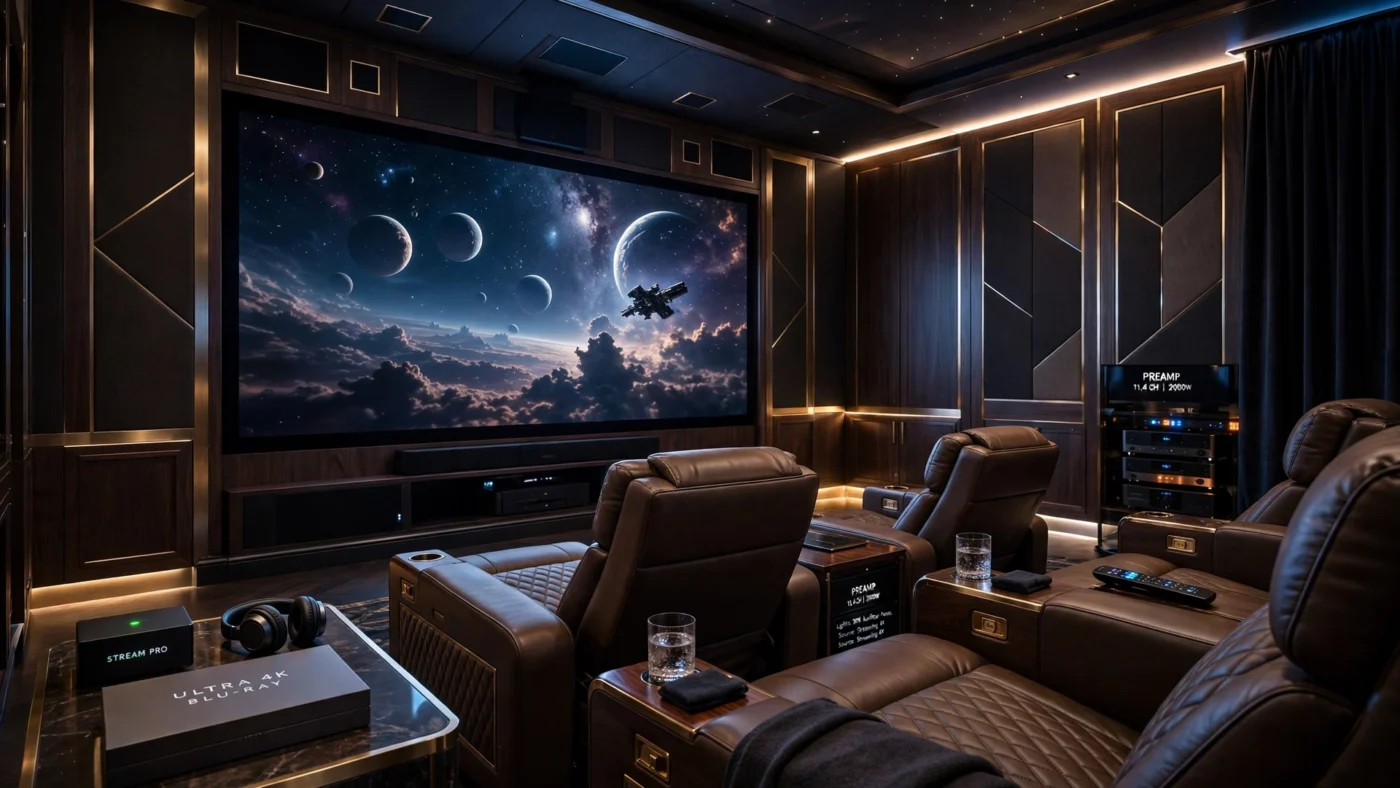
The private home screening room has evolved far beyond reclining theater seats and movie posters. Today’s high-end entertainment salons represent acoustic and optical masterpieces that rival Hollywood grading suites while serving as sumptuous entertaining spaces. This guide explores how modern home entertainment technology blends reference-grade performance with refined interior design.
Ultra-Short-Throw Tri-Chroma Laser Cinema
Where traditional ceiling-mounted projectors required lengthy throw distances and visible conduits, modern Tri-Chroma Ultra-Short-Throw (UST) laser projectors from brands like Leica Cine 1 and Sony sit mere inches from the wall on a low credenza. Paired with Ambient Light Rejecting (ALR) motorized drop-down screens, they cast 120-inch 4K HDR images with vibrant color gamut accuracy even in daytime ambient light.
Discrete Multi-Channel Dolby Atmos Architecture
An immersive cinema experience is 50% acoustic. Implementing a 9.4.6 Dolby Atmos setup with four subwoofers placed strategically across room nodes eliminates acoustic dead zones. Working with acoustic engineers to conceal acoustic diffusers and bass traps behind acoustically transparent fabric walls preserves a serene residential aesthetic.
Acoustic Room Isolation
A true private cinema must utilize decoupled stud construction, resilient clips, and acoustic laminated glass doors to prevent low-frequency bass rumble from disturbing other family members elsewhere in the estate.
Reference Vinyl and Digital Hi-Fi Systems
The ritual of playing analog vinyl has enjoyed a massive resurgence in luxury homes. Turntables like the McIntosh MT10 with its illuminated green platter and sapphire tonearm bearings pair with vacuum-tube preamplifiers to deliver warm, organic analog sound that digital compression simply cannot match.
How to Plan Home Entertainment Technology for Your Space
Start with the room, not the gear. Measure viewing distances — roughly 1.2 to 1.5 times the screen diagonal for 4K — assess ambient light, and decide whether the space is a dedicated cinema or a shared living room. Dedicated rooms allow total light control and full acoustic treatment, while shared spaces demand ALR screens, discreet in-wall speakers, and furniture-friendly components. Engage an AV integrator early, ideally before drywall, so conduit, speaker wire, and acoustic framing are roughed in cleanly.
Budget with a clear formula. A true reference home entertainment technology installation typically allocates around 40 percent to the display, 35 percent to audio, and 25 percent to room treatment, seating, and control systems. Always demo before you buy: projector brightness specs mislead, so view the exact model in a darkened showroom, and bring familiar music to test dialogue clarity at low volumes — a system that only impresses at concert levels will fatigue during films.
Protect your upgrade path. Choose a nine-channel AV receiver even if you begin with five speakers, and run conduit to every speaker location so future formats never require opening finished walls. Standardize on one control platform for lighting, screen, and source switching so the entire room responds to a single elegant keypad or voice command.
Common Mistakes When Installing Home Entertainment Technology
The costliest mistake is treating the room as an afterthought. Bare drywall and hardwood floors create slap echo that no equalizer can fully correct, so budget for absorption at first reflection points and bass trapping in corners from the outset. Second, oversizing the display for the seating distance causes eye strain and neck fatigue — follow SMPTE viewing-angle guidelines rather than showroom bravado.
Third, neglecting ventilation. Projectors and amplifiers generate serious heat, so plan quiet exhaust or a ventilated equipment closet rather than sealing gear inside unvented cabinetry. Finally, do not daisy-chain inexpensive power strips behind the rack; a dedicated 20-amp circuit with surge protection and power conditioning safeguards six-figure home entertainment technology from brownouts, spikes, and ground-loop hum.
Design Details That Keep the Room Luxurious
Concealment separates a true media salon from a mere equipment room. Motorized screens descend silently from ceiling coffers, speakers hide behind acoustically transparent fabric panels color-matched to the walls, and source components live in a remote rack with infrared repeaters — leaving only beautiful millwork and art visible. Lighting design matters as much as audiovisual gear: layered sconces, step lights, and bias lighting behind the display reduce eye fatigue while adding cinematic drama.
Choose seating with correct sightlines, using risers for second rows so every guest enjoys an unobstructed view. Select acoustic-friendly upholstery fabrics that absorb rather than reflect high frequencies, and integrate blackout drapery that doubles as an acoustic absorber. The goal is a room that feels like a luxurious lounge first and reveals its technical prowess only when the lights dim.
Frequently Asked Questions About Home Entertainment Technology
Is a projector or a large television better?
For screens above 100 inches, ultra-short-throw laser projectors win on cinematic scale and value; below 85 inches, OLED televisions deliver superior contrast with far simpler installation. The deciding factor is light control: projectors demand darkened rooms or ALR screens, while televisions thrive in bright, multipurpose spaces.
How much does a high-end setup cost?
A refined 5.1 living-room system typically starts around $15,000. A dedicated Dolby Atmos cinema with professional acoustic treatment generally runs $60,000 to $150,000, while no-compromise screening rooms with reference-grade everything can exceed $250,000.
Can the equipment be hidden when not in use?
Absolutely. Motorized drop-down screens, in-wall and in-ceiling speakers, and remote equipment racks allow the entire system to vanish, leaving an elegant living space behind. Disappearing act design is where great home entertainment technology truly shines — performance on demand, serenity the rest of the time.
Do I need an acoustician for a home theater?
For dedicated cinema rooms, professional acoustic modeling is money well spent; it prevents costly errors in speaker placement, bass management, and treatment selection. For shared living-room systems, an experienced AV integrator can achieve excellent results without a separate acoustician.
For a deeper dive into the history and standards behind these systems, explore the home theater article on Wikipedia.
Conclusion
An exceptional home entertainment space is an invitation to gather with family and friends, experiencing cinema, gaming, and musical performances in unparalleled luxury.