Luxury Home Office Design Ideas: 15 Looks for 2026
The home office stopped being a spare room with a desk years ago. For remote executives, founders, and anyone whose video calls double as first impressions, it is now the most-viewed room in the house. These luxury home office design ideas aren’t a mood board of pretty pictures — each one is a complete look with the materials, lighting, and layout decisions that make it work in 2026.
15 luxury home office design ideas
1. The paneled library office
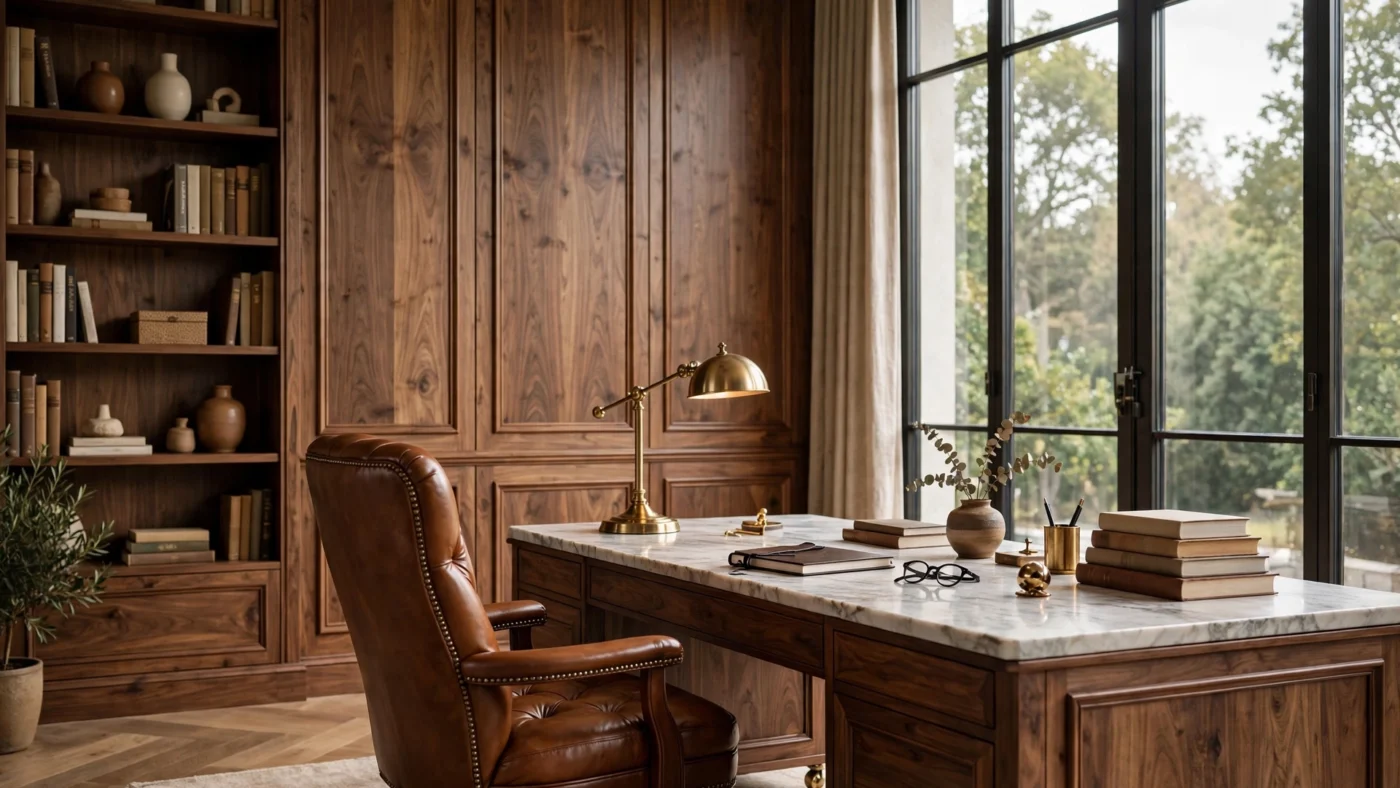
Floor-to-ceiling walnut or ebonized-oak paneling with integrated shelving turns a study into a private club room. How to nail it: run the paneling across all four walls for full immersion, not just one accent wall; mix closed cabinets at the bottom with open shelves above; add a brass picture light over the desk zone.
2. The minimalist floating desk
A single slab of honed marble or solid oak, cantilevered from the wall with hidden steel brackets — no legs, no visual weight. How to nail it: the slab must be at least 2 inches thick to read as architectural; hide all cables through a routed channel in the slab; pair with one sculptural chair so the composition stays clean.
3. The marble executive desk centerpiece
A double-pedestal desk with a marble top, set in the center of the room facing the door — the classic power position. How to nail it: center the desk on the rug with equal clearance on both sides; a rug at least 24 inches wider than the desk on every side anchors the zone; add matching marble or stone accessories for cohesion.
4. The double-height window wall
If you have the architecture, nothing reads as luxury like daylight. A full window wall behind the desk floods the room and puts the view in your video background. How to nail it: position the desk perpendicular to the glass to avoid screen glare; add sheer linen shades plus blackout drapes for call control; tint considerations aside, UV film protects leather and wood from sun fade.
5. The velvet reading corner
A second seating moment — a club chair, a floor lamp, a side table — signals the office is a room, not a workstation. How to nail it: velvet or bouclé upholstery in a jewel tone; a floor lamp at 1,500–2,000K-equivalent warm light for the corner; a small rug to define the nook inside the larger room.
6. Hidden-clutter built-ins
Luxury is the absence of clutter. Wall-to-wall cabinetry with push-latch doors hides printers, files, and tech gear completely. How to nail it: ventilate printer cabinets; route power inside; keep one open shelf per wall of closed storage so the room doesn’t feel like a vault. This is combining comfort and luxury at home at its most practical.
7. The statement pendant or chandelier
Yes, in an office. A sculptural pendant or small chandelier over the desk zone replaces the forgotten ceiling fan and announces that the room was designed, not assembled. How to nail it: hang it 30–36 inches above the desk surface; choose 2,700–3,000K warm dimmable; keep the diameter under two-thirds of the desk width so it doesn’t overwhelm.
8. The dark, moody study
Deep forest green, oxblood, or charcoal walls with brass and cognac leather — the 2026 answer to the all-white office. How to nail it: dark walls need 30% more light than light walls to feel the same brightness, so add an extra layer of accent lighting; satin finishes reflect better than flat in dark rooms.
9. The light Scandinavian-luxe office
Pale oak, ivory plaster walls, a linen-upholstered chair, and one black accent for definition. How to nail it: warmth comes from texture, not color — layer wool, linen, and pale wood; keep the palette to three neutrals maximum; hide every cable, because pale rooms show everything.
10. The gallery art wall
A curated wall of framed art behind the desk doubles as the world’s best video-call background. How to nail it: large pieces beat many small ones; hang the center of the arrangement at 57–60 inches; mix photography with abstract work; museum-style picture lighting elevates the whole wall.
11. The convertible meeting table
A round or oval meeting table instead of (or beside) a desk — for the founder who hosts in the office. How to nail it: 48–60 inches seats four comfortably; a pendant centered above it; keep chairs consistent and upholstered, never a mismatched set.
12. The biophilic, plant-layered office
Layered greenery — a tall fiddle-leaf fig, trailing pothos on shelves, a small olive tree by the window — softens every hard surface. How to nail it: choose plants by your actual light (bright window = olive or fig; low light = ZZ or snake plant); hide nursery pots inside stone or ceramic cachepots; one large plant beats five small ones.
13. The video-call-ready acoustic office
For the person on camera all day: fabric-wrapped acoustic panels, a thick rug, and heavy drapes kill echo so the room sounds as good as it looks. How to nail it: panels at first-reflection points (side walls and behind the camera); upholstered furniture counts as absorption; test with a 10-second voice memo before buying anything.
14. Brass-and-leather executive detailing
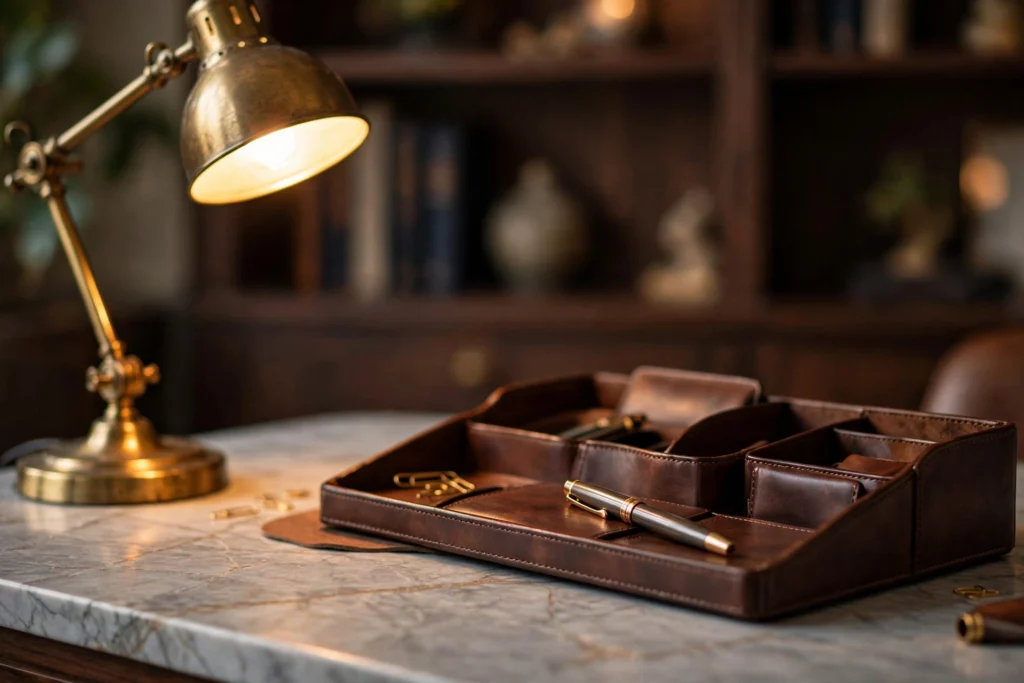
The small things: a brass desk lamp, leather desk pad, a proper pen cup, a decanter tray. How to nail it: pick one metal and repeat it at least three times (lamp, frames, hardware); leather in one tone across pad, chair, and storage boxes; nothing plastic visible on the desk.
15. The dual-zone couples’ office
Two workstations in one room, zoned with a shared bookcase or a console table between them. How to nail it: back-to-back desks save floor space and keep screens private; give each zone its own task light; one shared rug unifies the room while separate desk chairs define the zones.
Layout rules: the luxury office floor plan
- Desk faces the room, not the wall. The power position — desk in the center or facing the door — photographs better, feels better, and gives your video background the whole room.
- Zone in threes: work zone (desk), thinking zone (seating nook), storage zone (built-ins). Three defined zones make even a 10 × 12-foot office feel designed.
- Clearance: 36 inches behind the desk chair for comfortable movement; 24 inches minimum between zones.
- Background check: sit in your video-call chair and photograph what the camera sees. That view is your real design brief.
The lighting plan: lux levels for a home office
A home office needs real light, not vibes. Aim for 300–500 lux on the desk surface for focused work — that’s roughly 30–50 lumens per square foot of office floor area. Layer it: daylight first (desk perpendicular to the window), a warm 2,700–3,000K ambient layer on dimmers, and a dedicated task lamp with adjustable brightness for late work. CRI 90+ bulbs render skin tones and materials honestly on camera. Lighting levels this deliberate are what separate a designed office from a spare bedroom with a laptop — plan your office lighting with real numbers before you buy a single fixture.
The cable-hiding checklist
- Route monitor and dock cables through a desk grommet or cable spine — nothing should drape.
- Mount the power strip under the desk, not on the floor.
- Use a cable box or basket for the inevitable chargers; match it to the room (leather, wood, or stone).
- Run one cable raceway to the wall outlet and paint it to match the wall.
- Wireless where it counts: keyboard, mouse, and printer go wireless; keep wired only what’s faster for it.
5 mistakes that make a home office look cheap
- The wall-facing desk. Pushed against the wall like a dorm room — the fastest way to flatten a luxury office.
- Visible cables. One dangling cord undoes a $5,000 desk. Hide everything.
- Office-chair syndrome. A mesh task chair with plastic arms in an otherwise elegant room. Choose leather or upholstered, or at least a designer task chair.
- Flat overhead-only lighting. A single ceiling light makes everyone look tired on camera and the room feel institutional. Layer it.
- Fake plants. In a luxury room, a dusty fake plant is worse than no plant. If you can’t keep one alive, use sculptural branches or nothing.
Luxury home office design FAQs
How much does a luxury home office cost to furnish?
A designed, high-end home office typically runs $5,000–$25,000 depending on furniture quality and built-ins — the desk and chair are the two pieces worth the largest share of the budget.
What colors work best for a luxury home office?
Deep, saturated neutrals — forest green, charcoal, oxblood, warm taupe — read as luxury and focus the mind. Pair with brass or black metal accents and one rich material like walnut or marble.
Where should the desk go in a home office?
In the power position: facing the room or the door, not pushed against a wall. Near a window for daylight, but perpendicular to the glass to avoid screen glare.
How do I make my home office look good on video calls?
Design the background the camera sees: a gallery wall, bookshelves, or paneling behind you; warm 2,700–3,000K lighting on your face from the front; acoustic treatment so the room sounds as good as it looks.
What’s the best lighting for a home office?
Layered: daylight first, 300–500 lux on the desk from a dimmable ambient layer plus an adjustable task lamp, CRI 90+ bulbs, all warm 2,700–3,000K for a luxurious feel.