Luxury Fireplace Design Ideas: 12 Statement Looks for 2026
The Fireplace Is the Room’s Anchor — Design It Like One
The best luxury fireplace design ideas start with a simple truth: every luxury living room has a gravitational center, and more often than not, it is the fireplace. It is where eyes land first, where seating arranges itself, and where the whole room’s sense of scale gets decided. A well-designed fireplace makes everything around it — the furniture, the art, the lighting — look intentional. A weak one makes the same room feel oddly unfinished, no matter how much was spent on the sofa.
The difference between an ordinary fireplace and a luxurious one is rarely the size of the budget. It is specificity: the right material, the right proportions, and details that feel considered rather than default. Below are twelve luxury fireplace design ideas that do exactly that — each with practical notes on how to pull it off. Once the fireplace is set, the surrounding light layers decide the evening mood — browse our luxury lighting ideas and try the Luxury Lighting Calculator to plan the room around the fire.
1. Floor-to-Ceiling Book-Matched Marble
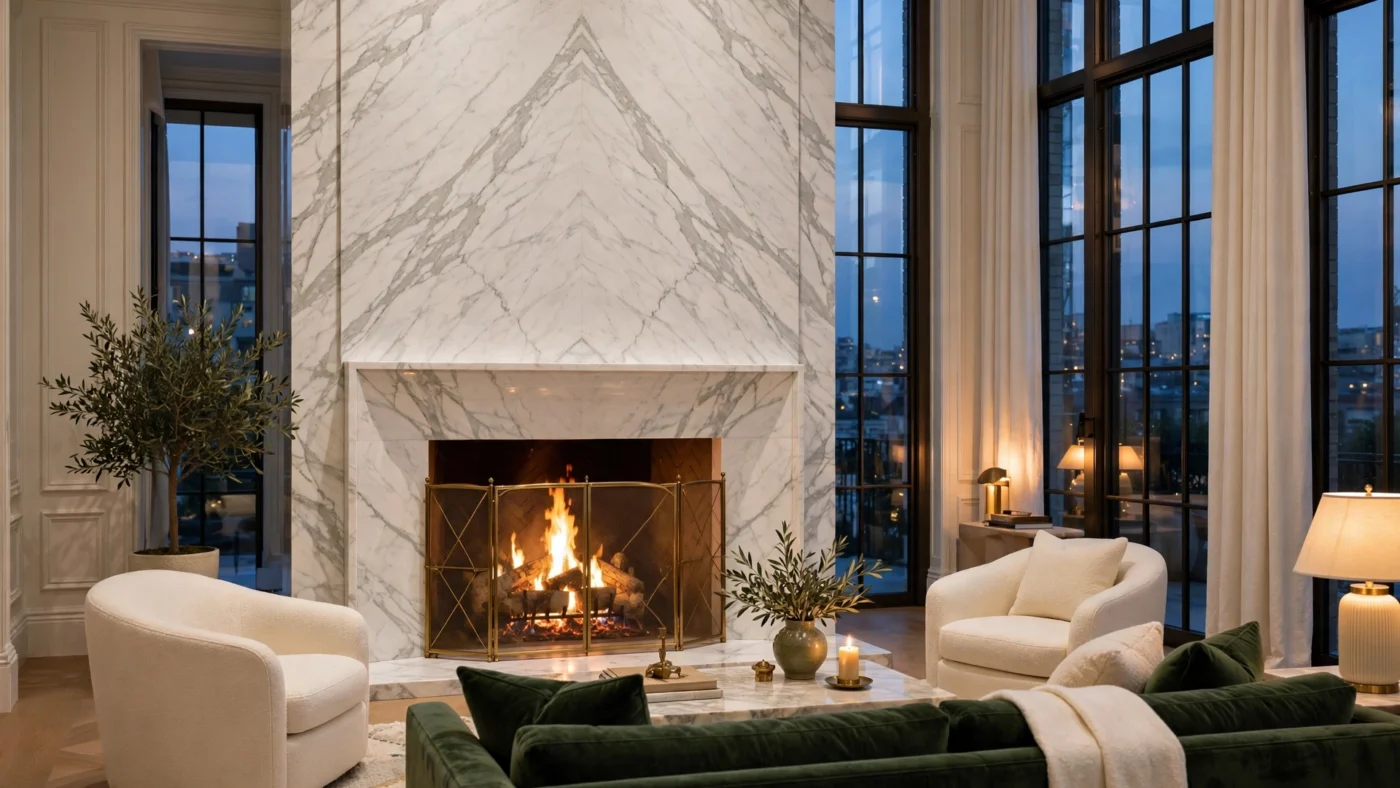
A single dramatic stone slab, mirrored at its center seam so the veining opens like butterfly wings, running from floor to ceiling. This is the definitive luxury fireplace statement. How to nail it: choose slabs with bold, continuous veining (Calacatta or dramatic quartzite); keep the firebox opening clean and frameless so the stone is uninterrupted; flank with nothing — the slab is the whole composition. It works best in rooms with at least 9-foot ceilings, where the verticality can breathe.
2. The Linear Gas Fireplace as a Horizontal Horizon
Long, low, and frameless, the linear gas fireplace reads as a ribbon of flame rather than a box. It suits modern rooms the way a horizon suits a landscape. How to nail it: recess it flush into the wall with no protruding surround; finish the surrounding wall in limewash or honed plaster so the flame is the only texture; run it wide — 48 to 72 inches — so it holds its own against a large seating arrangement.
3. Double-Sided Fireplaces for Open Plans
A see-through firebox shared between the living room and the dining room (or bedroom and bath) is architecture and ambiance in one move. It divides space without closing it off. How to nail it: design both faces with equal care — the “back” side is seen just as often; keep sightlines through the glass unobstructed with low, transparent fire media like clear glass beads; make sure the surround material works from both rooms’ palettes.
4. Carved Limestone in a Traditional Shell
For classic interiors, nothing beats a hand-carved limestone surround with proper moldings and a substantial mantel shelf. The softness of limestone photographs beautifully and ages with grace. How to nail it: insist on real depth in the carving — shallow moldings look flat under evening light; pair with a wood-burning firebox and a proper timber mantel beam for the full country-estate feel; keep the hearth wide enough to actually sit on.
5. The Suspended Fireplace as Sculpture
A rotating, ceiling-hung firebox is part fireplace, part mobile sculpture. It frees the floor plan entirely and becomes the room’s conversation piece before the fire is even lit. How to nail it: give it a full 360 degrees of clearance and let it rotate; keep the surrounding furniture low so the floating form stays the visual hero; choose a matte black or brushed steel finish that reads as intentional metalwork, not an appliance.
6. Blackened Steel and Dark Honed Granite
For the moody, masculine luxury look: a firebox wrapped in blackened steel or dark honed granite, with the flame providing the only warmth of color. How to nail it: contrast the dark surround with pale walls or light oak floors so the fireplace reads as a deliberate anchor, not a hole in the wall; use fire glass in deep bronze or amber tones; keep the mantel line razor-clean — this look dies with clutter.
7. The Outdoor Fireplace as a Second Living Room
A properly designed outdoor fireplace extends the luxury footprint of the house by a whole room. Stone or board-formed concrete, a deep hearth, and seating built for long evenings. How to nail it: use weather-rated materials (natural stone, stainless steel) and a chimney scaled to the patio, not the house; add low-voltage landscape lighting around it so the fireplace glows as a destination from inside; include a wood-storage niche in the design — stacked logs are decor.
8. Travertine and Tadelakt: Warm Minimalism
Not every luxury fireplace needs drama. A softly textured travertine or tadelakt (polished Moroccan plaster) surround in warm ivory tones brings quiet, spa-like luxury — especially beautiful in bedrooms. How to nail it: keep every edge soft and slightly rounded; pair with natural linen upholstery and unlacquered brass; skip the mantel shelf entirely and let the material’s texture be the decoration.
9. The Fireplace as Media Wall, Done Right
Fireplace below, television above is the most requested layout in modern homes — and the most botched. Done right, it is sleek and symmetrical. How to nail it: recess both into a single paneled wall so they read as one composition; keep the TV no higher than comfortable viewing height (the top of the screen roughly at seated eye level plus a touch) — mounting it at the ceiling is the classic mistake; hide every cable and component in the flanking cabinetry.
10. Two-Story Fireplaces for Volume
In double-height living rooms, a fireplace that runs the full two stories is the only element with the presence to match the volume. Stone, stacked in long horizontal courses, emphasizes the scale. How to nail it: break the verticality with a single strong horizontal element — a chunky floating mantel or a steel beam — so the eye has somewhere to rest; light it with picture-style wash lights from above so the stone texture glows at night; keep furniture scaled up to match.
11. The Corner Fireplace, Reconsidered
Corner fireplaces have a dated reputation, but a modern angular design — a clean triangular firebox in honed concrete or steel — can anchor an awkward corner better than any furniture arrangement. How to nail it: angle the seating to face it directly rather than treating it as an afterthought; choose materials that match the room’s main fireplace language so it feels designed, not leftover; keep the profile slim.
12. Jewel-Box Tile: Emerald, Sapphire, and Onyx
Handmade zellige or glass tile in deep emerald, sapphire, or black onyx turns the fireplace into a piece of jewelry. The uneven glaze catches firelight in a way flat stone never does. How to nail it: take the tile all the way to the ceiling for full effect — a partial tile job looks indecisive; grout in a matching tone so the color field stays continuous; pair with a simple oak or stone mantel and let the tile do all the talking.
Proportion Rules: The Math Behind the Beauty
Beautiful fireplaces obey quiet rules. The luxury fireplace design ideas above all follow a few that designers rely on:
- Surround width: the mantel shelf typically runs about one and a half times the width of the firebox opening — enough to frame the fire without dwarfing it.
- Mantel height: in living rooms, the mantel shelf usually sits 48 to 54 inches from the floor; art hung above it should be roughly two-thirds the mantel’s width.
- Clearances: every unit has manufacturer-specified clearances to combustible materials — follow them exactly and confirm against local codes before finalizing the design. This is non-negotiable.
- Room scale: a petite surround disappears in a grand room; an oversized one bullies a small one. Match the fireplace’s visual weight to the room’s volume, not just its wall.
Fuel Types: Gas, Wood, or Electric?
Each has an honest place in luxury design. Gas offers instant ambiance, clean burning, and linear formats no wood fire can match — the default for modern luxury. Wood-burning brings the crackle, scent, and ritual that gas cannot fake; it suits traditional and rustic-luxury homes where the fireplace is a lifestyle, not just a look. Electric has matured enormously — today’s best units offer convincing flame effects with zero venting, making them ideal for apartments, bedrooms, and retrofits where flues are impossible. Choose for how you live, not for prestige. For the technical background on venting and clearances behind these luxury fireplace design ideas, see the fireplace overview on Wikipedia.
5 Fireplace Mistakes That Cheapen the Look
- TV mounted at the ceiling. The neck-craning cliché. Keep the screen low and integrated.
- Undersized art above the mantel. A small frame floating on a big chimney breast looks lost — scale art to the mantel.
- Fake stone panels. Flat, repetitive faux-stone reads as exactly what it is within seconds. If the budget is tight, a clean plastered surround beats imitation stone every time.
- Ignoring the hearth. The hearth grounds the whole composition; a fireplace with no defined hearth looks like it is hovering.
- Matchy-matchy mantel styling. Symmetrical pairs of identical objects scream showroom. Style the mantel with varied heights and one organic element — branches, stone, or a sculptural object.
Luxury Fireplace Design Ideas: FAQs
What is the most luxurious fireplace material?
For luxury fireplace design ideas, book-matched marble is the classic answer — its natural veining makes every installation one of a kind. Dramatic quartzite, hand-carved limestone, and onyx (which can be backlit) are equally luxurious choices, each with a different character.
How wide should a fireplace mantel be?
A common designer guideline is a mantel shelf about one and a half times the width of the firebox opening. Artwork hung above should be roughly two-thirds the mantel’s width for balanced proportions.
Are linear gas fireplaces a good luxury choice?
Yes — for modern interiors they are one of the strongest options. Their wide, frameless flame suits contemporary rooms, they offer clean-burning efficiency, and many integrate with smart home systems for remote flame and heat control.
Can a fireplace work in a small living room?
Absolutely. Choose a wall-mounted or linear electric unit, keep the surround slim and light-toned, and let the fireplace share a wall with built-in shelving so it earns its footprint twice over.
Gas vs. wood fireplace for a luxury home?
When weighing luxury fireplace design ideas, gas wins for convenience, clean lines, and modern formats; wood wins for sensory richness — crackle, scent, and ritual. Many luxury homes now pair a primary gas fireplace in the living room with a wood-burning unit in a secondary space like a study or outdoor pavilion.