Luxury Humidifier: The 2026 Buying Guide
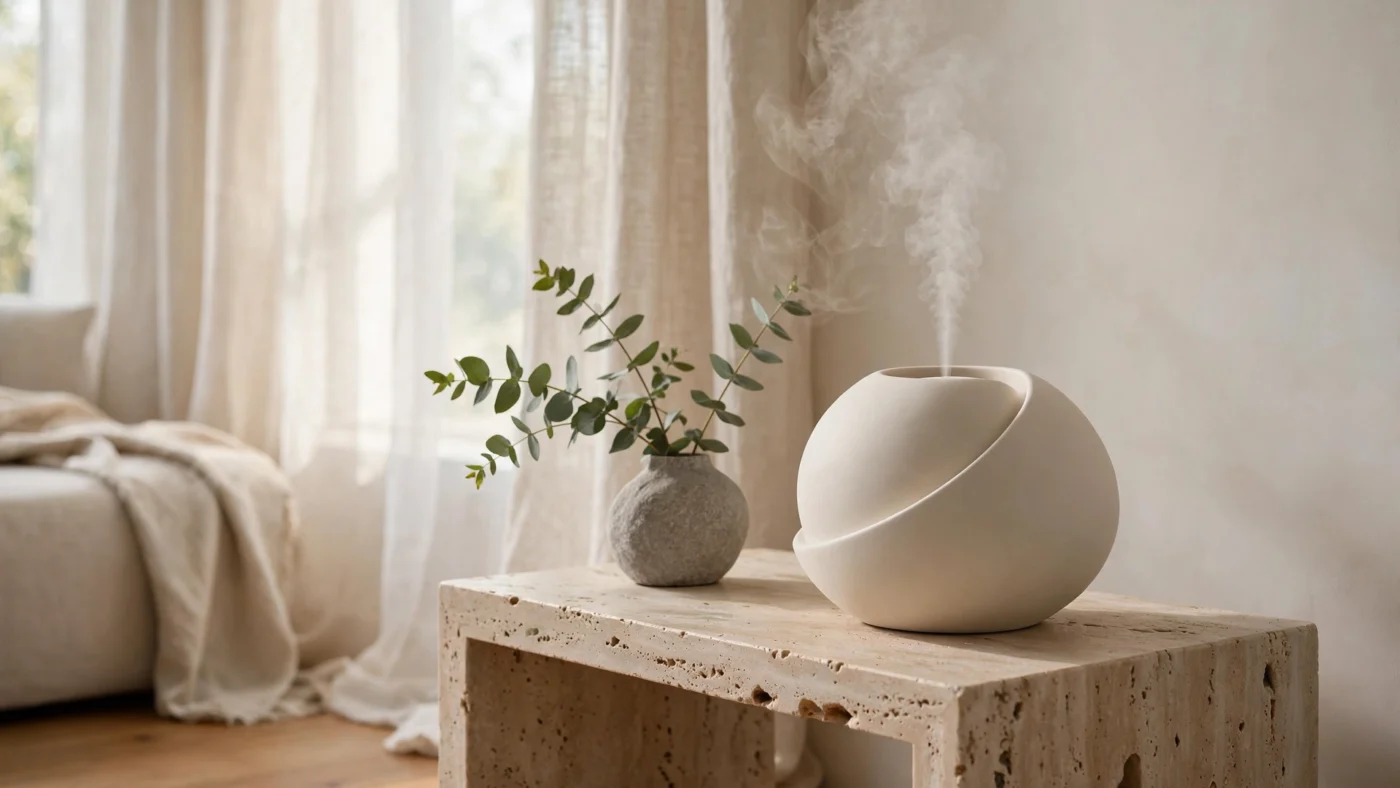
A luxury humidifier has one job no ordinary humidifier takes seriously: to earn its place in the room. Dry winter air is real — it irritates sinuses, cracks lips, disrupts sleep, and quietly damages wood floors, instruments, and artwork. But the standard humidifier is a plastic tank with glowing buttons and visible water lines, an object that fights the interior it sits in. This guide covers what actually matters when you buy at the top of the category: the room-matching math, the technology types, the noise and maintenance details that separate luxury from marketing — and the design-forward luxury humidifier picks that belong in a considered home in 2026.
Why humidity belongs in a luxury home
Comfort, health, and preservation — a proper humidity strategy covers all three, and a luxury humidifier is how that strategy shows up in the room. The target most guidance converges on is 30–50% relative humidity for general living spaces, rising to 40–60% in the bedroom for sleep quality, skin health, and respiratory comfort. Below 30% you get dry skin, cracked lips, and restless sleep; above 60% you risk mold growth and condensation damage.
The preservation angle is the one luxury humidifier buyers care about most: stable humidity protects hardwood floors, fine furniture, pianos, guitars, and art on paper. A whole-home system quietly doing this job in the background is the difference between maintaining a home and constantly repairing one.
Room-matching math: buy for the room you have
The two numbers that decide whether a luxury humidifier works are coverage and capacity:
- Coverage (square feet): match it to the room, generously. A 219-sq-ft bedroom unit belongs in the bedroom; an 860-sq-ft unit belongs in the open-plan living space. Oversizing slightly is better than undersizing — an undersized unit runs constantly and still never reaches target humidity.
- Capacity (tank size / runtime): this decides how often you refill. A 1.5-liter bedroom unit may need daily attention; a 6-liter tank can run a large bedroom for days. For luxury, convenience is the product — set-and-forget runtime is worth paying for.
A quick sizing cheat sheet:
- Nightstand / personal desk: small ultrasonic, up to ~300 sq ft coverage
- Master bedroom: 300–600 sq ft coverage, 2–4 liter tank, light-free night mode
- Open-plan living / kitchen: 600–860+ sq ft coverage, 4–6 liter tank or whole-home system
- Entire house: HVAC-integrated whole-home humidifier — nothing to refill, nothing on the shelf
The four types, honestly compared
- Ultrasonic: the quietest and most efficient technology — near-silent operation (often 26–30 dB), fine cool mist. The technology of choice at the luxury end, and the one behind every design-forward model worth buying. Watch for mineral “white dust” with hard tap water — distilled water solves it.
- Evaporative: a fan blows air through a wet wick filter. Self-regulating (harder to over-humidify) and good for large spaces, but fan noise and wick filters that need replacing are the trade-offs. Less common in luxury portable models.
- Warm mist / steam: boils water to release sterile steam. Quiet-ish and hygienic, but energy-hungry, slower, and the warm tank needs care around children. Rarely the luxury pick.
- Whole-home (HVAC-integrated): systems like AprilAire connect to the home’s heating and cooling and maintain humidity in every room automatically — no tanks, no refills, no shelf footprint. If you are renovating or building, this is the luxury answer; portable units are for everyone else.
What “luxury” actually buys you
At the top of the luxury humidifier category, you are paying for five things:
- Materials that belong in the room: ceramic shells, matte finishes, frosted glass, real wood bases — housings that hold up at close range and won’t off-gas or degrade. A humidifier you look at twice a day should be an object, not an appliance.
- Silence: under 30 dB for bedrooms — the difference between “whisper-quiet” as a spec and as a reality. Night modes that kill every indicator glow matter as much as the motor.
- Control: a real humidistat and automatic mode that holds your target humidity without babysitting — the unit should manage itself against weather swings.
- Clean air behavior: no white dust on the nightstand, no visible mist plume fogging the mirror, no condensation rings on the furniture.
- Maintenance design: wide openings, removable dishwasher-safe reservoirs, no fiddly corners where mold colonizes. A luxury humidifier is one you will actually clean — because it was designed to be cleaned.
The 2026 shortlist: design-forward picks that perform
The luxury humidifier category matured fast, and 2026 comparisons have converged on a clear set of design-forward models — chosen with the same design-first logic as our luxury espresso machine buying guide. Prices below are approximate current retail from manufacturer and retailer pages — always verify before buying.
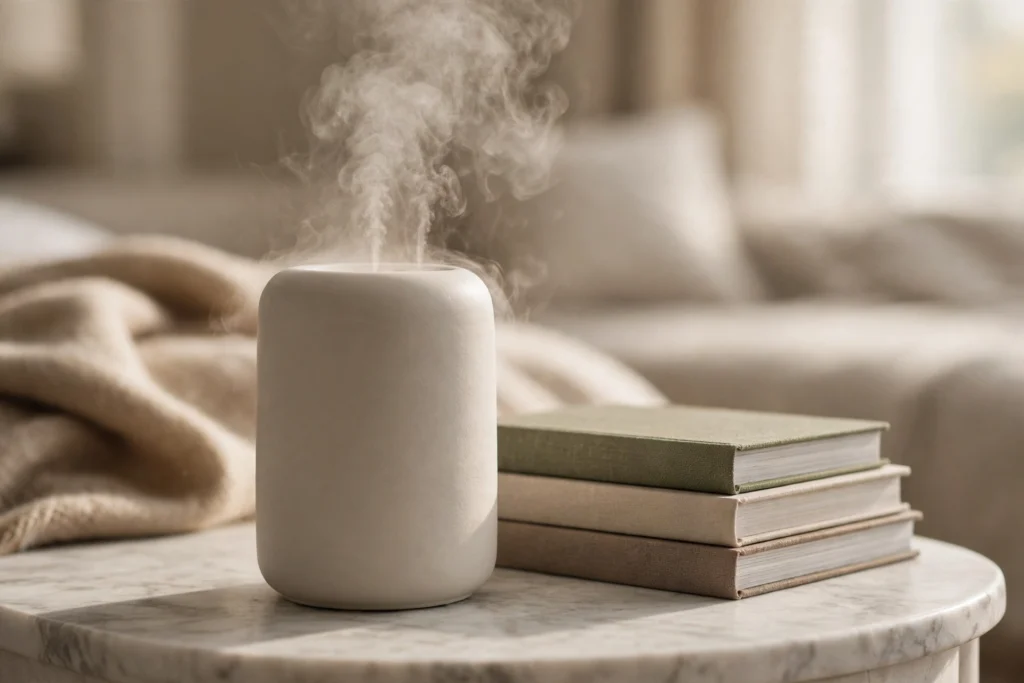
- Vitruvi Cloud (~$245): the sculptural pick — a curved matte-ceramic shell (Dove, Oat, Charcoal) with the water reservoir completely hidden inside, so there are no visible water lines or stagnant-water views from across the room. Around 600 sq ft coverage, 1.5L removable dishwasher-safe bucket, whisper-quiet ultrasonic operation near 27 dB, light-free night mode, 360° rotating mist spout. The humidifier that looks like studio pottery on the nightstand.
- Stadler Form Eva (~$200): Swiss minimalism with serious performance — the largest coverage in the design tier at up to 860 sq ft, Wi-Fi with an external humidity sensor that measures the room independently of the unit, dimmable LEDs, essential-oil compartment, and a 4L tank good for up to ~16 hours. The pick for large living spaces and master suites.
- Blueair DreamWell (~$160): the invisible approach — InvisibleMist technology disperses moisture with no visible mist output, which also means no white dust and no condensation rings. Aroma stone for scent layering, dimmable mood lighting, sized deliberately for the bedroom (~219 sq ft). For the sleep sanctuary where every sensory input is controlled.
- Objecto H3 (~$169): compact Scandinavian cool-mist in white, matte black, and bolder finishes, with an aroma tray built into the base. Up to 350 sq ft coverage and 18-hour runtime from a 2L tank — sized for bedrooms, home offices, and wellness rooms.
- Levoit Classic 300S (~$60): the smart value pick — app-controlled target humidity, auto and sleep modes, up to 500 sq ft coverage and a 6L top-fill tank at the most accessible price in the design tier. Proof that “design-forward” and “smart” no longer require a premium.
- Muji Ultrasonic (~$65): the purist’s choice — frosted white cylinder on a warm wood base, no visible buttons or branding, a fine meditative mist. Small-to-medium rooms; the wabi-sabi answer to air quality.
And the honest luxury endpoint: if you own the home and run central HVAC, a whole-home system (AprilAire-style, plumbed into the ductwork) beats every portable luxury humidifier on convenience. Nothing to refill, nothing to look at, every room held at target.
Noise and water: the two details that decide everything
Noise: bedrooms need under 30 dB — a quiet conversation is 60 dB, a whisper is 30. Ultrasonic luxury humidifier models live here naturally; evaporative fans do not. Check the spec at the setting you will actually use, not just the lowest mode. And since the bedroom is a whole sleep system, our bedroom lighting lumens guide covers the light half of the equation.
Water: distilled or filtered water in ultrasonic luxury humidifier models prevents the mineral white dust that settles on every dark surface in the room, and it stretches the time between deep cleans. Clean the unit at least weekly — every three days for daily-use bedroom models. A unit with a wide opening and a removable reservoir gets cleaned; a unit with a narrow neck and hidden corners grows things. This is the least glamorous luxury criterion and the most predictive of whether you keep using it.
Pair the air strategy with our luxury air purifier buying guide — humidity and filtration are the two halves of air you can feel, and a luxury humidifier covers the first half.
Placement rules
- Elevated, flat surface — a nightstand, console, or shelf, not the floor and not carpet.
- A few feet from walls and electronics; mist drifting into a speaker grille is not a design feature.
- Cool-mist units are placement-flexible; warm-mist units stay meters from the bed for safety.
- Near the return-air path of the room if you want one unit to cover more space — moving air distributes moisture.
- Never add essential oils to a humidifier not designed for them — oils damage ultrasonic membranes and void warranties. Use the aroma tray or a separate diffuser.
5 luxury humidifier mistakes to avoid
- Buying for price, not the room. An undersized unit running at full tilt 24/7 is louder, uglier, and less effective than the right-sized one on auto.
- Ignoring the decibel spec. “Quiet” is marketing; under 30 dB on your actual setting is a fact. Verify it.
- Tap water in an ultrasonic unit. Hard water leaves white mineral dust on everything — distilled or filtered water is the running cost of invisible air.
- Over-humidifying. Above 60% you are growing mold and fogging windows. A humidistat or auto mode is not optional at this price.
- Choosing the appliance look to save money. You will look at it twice a day for years. The design-forward premium amortizes fast.
Luxury humidifier FAQs
What humidity level should I maintain at home?
30–50% relative humidity for living spaces; 40–60% in the bedroom for sleep, skin, and respiratory comfort. Below 30% causes dryness and disrupted sleep; above 60% risks mold and condensation.
Are expensive humidifiers worth it?
The luxury humidifier premium buys materials that suit the room, true sub-30 dB silence, automatic humidity control, and maintenance-friendly design. If the unit sits in a visible room and runs daily, those are daily-experience upgrades — worth it.
Ultrasonic or evaporative humidifier — which is better?
Ultrasonic is quieter and more efficient, and every luxury humidifier shortlist is dominated by it — but it needs distilled water to avoid mineral dust. Evaporative is self-regulating and good for large spaces, with fan noise and filter replacements as trade-offs.
Can I use essential oils in my humidifier?
Only in models with a dedicated aroma tray or compartment (Objecto H3, Stadler Form Eva, Blueair DreamWell among them). Never add oils to a unit not designed for it — they damage ultrasonic membranes and void the warranty.
How often should I clean a humidifier?
At minimum once a week; every three days for daily-use bedroom luxury humidifier models. Empty the tank daily, deep-clean weekly, and use distilled water to slow mineral buildup.